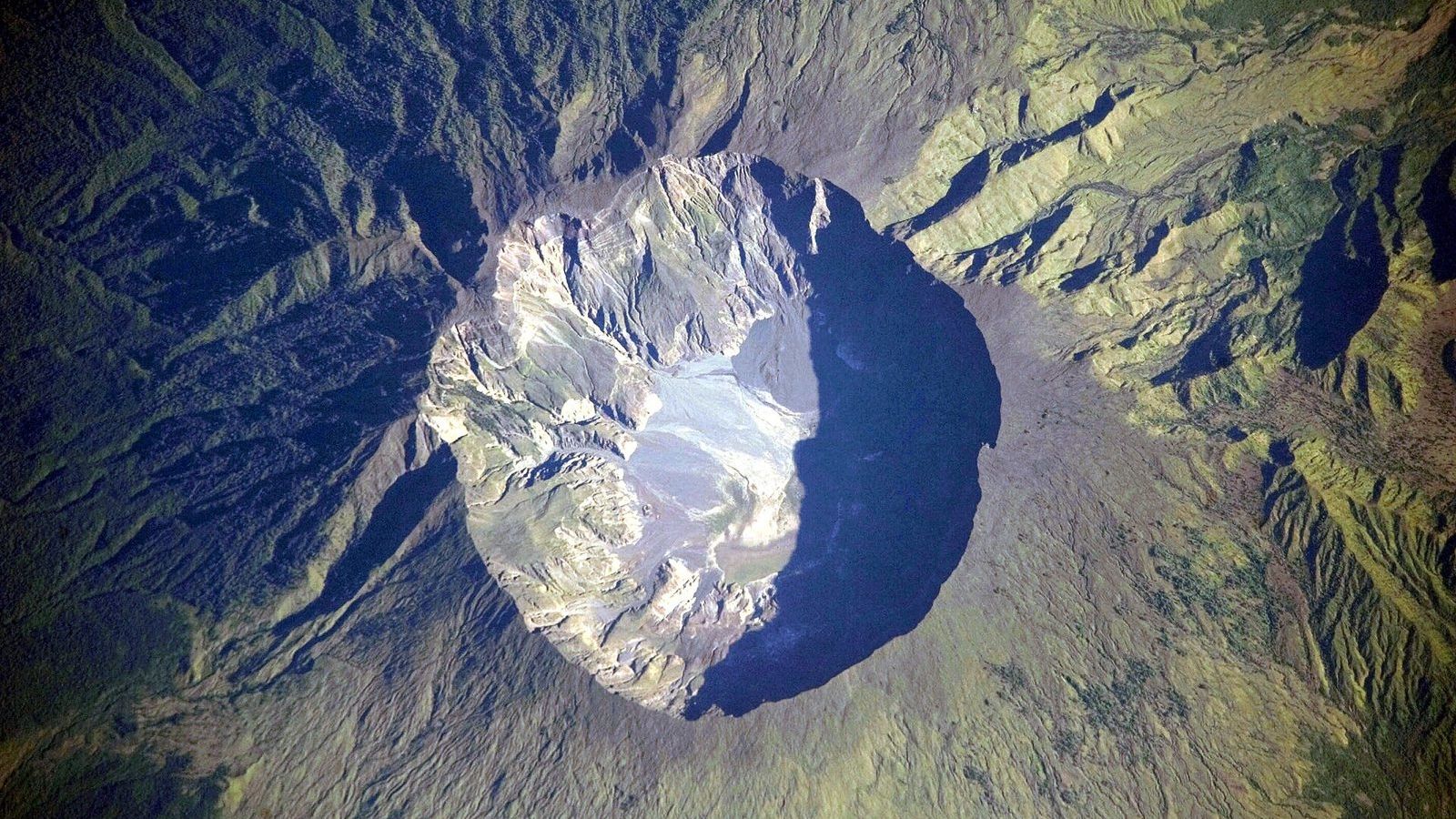
 Image: This image was taken by the NASA Expedition 20 crew. (public domain)
The year without a summer
Tambora, on the island of Sumbawa in Indonesia, was about 4,300 m high at the start of April 1815. By the evening of 11 April it was about 2,850 m high, with a caldera 6 km across and 1,100 m deep where the summit had been, which is what the astronaut photograph above shows. The eruption, which began on 5 April and reached its height on 10 April, was heard 2,600 km away in Sumatra, where the British governor sent troops out to look for the ship that he thought was firing its guns. It threw out somewhere between 30 and 50 km³ of magma, counted as dense rock, which is about forty times the 1980 eruption of Mount St Helens, and it has a Volcanic Explosivity Index of 7, the only eruption of that size in the last thousand years. Perhaps 10,000 people on Sumbawa died in the eruption itself and tens of thousands more in the famine and disease that followed on the island and its neighbours.
1816
The next year was cold across the Northern Hemisphere. In New England frost came in every month of the summer; snow fell in June in Vermont and New York, and the corn crop failed. In Europe the summer was wet and cold, the harvest failed from Ireland to Switzerland, grain prices doubled, and there was famine and typhus in the following winter; the Swiss canton of Bern had food riots. In Switzerland in that wet June, Mary Shelley, kept indoors by the weather at a villa on Lake Geneva, began Frankenstein. In China the Yunnan rice crop failed for three years. Temperature records from the time, reconstructed from instrumental series and from tree rings, put the average cooling of the Northern Hemisphere in 1816 at between about 0.4 and 0.7 °C, which sounds small until you notice that it is the difference between a harvest and none in a marginal climate.
Nobody in 1816 connected the weather to a volcano on the other side of the world. The connection was made in the twentieth century, by comparing the dates of great eruptions with the records of cold years, and confirmed when ice cores from Greenland and Antarctica showed a spike of sulfate in the layers of 1815 and 1816.
How a volcano cools the planet
The ash, the dramatic part of the eruption, is not what does it. Ash particles are large and fall out of the air within days or weeks. The cooling comes from sulfur dioxide, a gas that a large explosive eruption injects into the stratosphere, above the weather, 20 to 30 km up. There it reacts with water to form droplets of sulfuric acid, so small that they stay suspended for one to three years, and the layer of droplets, the sulfate veil, spreads around the world in months. The droplets scatter sunlight back to space. Less sunlight reaches the surface, and the surface cools.
The size of the effect depends on the sulfur, not on the volume of magma. Tambora's magma was rich in sulfur, and the ice cores and the deposits together suggest that it put about 60 million tonnes of sulfur dioxide into the stratosphere. A basaltic eruption of the same size that stayed low, like the Laki fissure eruption in Iceland in 1783, poisons the air downwind with sulfur but does not reach the stratosphere, and its climate effect is different and shorter. Unit 11 of the masterclass explains why explosive eruptions reach the stratosphere and effusive ones do not.
Pinatubo, the measured case
On 15 June 1991 Pinatubo in the Philippines erupted about 5 km³ of magma, index 6, a tenth of Tambora, and this time the satellites were watching. The eruption put about 20 million tonnes of sulfur dioxide into the stratosphere, measured directly by the Total Ozone Mapping Spectrometer on the Nimbus-7 satellite. The sulfate veil circled the globe in three weeks and covered both hemispheres within a year. The Earth Radiation Budget satellite measured the extra sunlight reflected to space, about 4 watts per square metre at the peak, which is several times the warming effect of all the carbon dioxide humans had added to the air by then, though only for a year. The global average temperature of 1992 was about 0.5 °C below the trend, and the effect had gone by 1994. The aerosol also destroyed ozone, which the same instruments measured, and it gave the climate modellers a test: a model run in 1991 by James Hansen's group at NASA, before the cooling appeared, predicted its size and its timing, and the measurements matched.
The worked number
How much does a volcano's cooling weigh against the warming from carbon dioxide? Pinatubo's 20 million tonnes of sulfur dioxide cooled the planet by about 0.5 °C for about a year and then faded, because the droplets fell out. The carbon dioxide added to the air by burning coal, oil, and gas, about 37 billion tonnes of it a year at present, stays for centuries, and it has raised the global average temperature by about 1.2 °C since 1850, a figure that keeps growing. The volcano is the larger effect for a year and the smaller one over a decade. Tambora, three times the sulfur of Pinatubo, cooled the Northern Hemisphere by perhaps 0.5 to 0.7 °C for about two years, enough to wreck harvests, and then the climate recovered completely. The lesson geologists draw is that the planet's temperature responds to what is in its air within months, and the difference between a volcano and a chimney is how long the addition stays there. Unit 16 takes that comparison much further back.
Could it happen again?
Eruptions of Tambora's size happen somewhere on Earth about once or twice a millennium; of Pinatubo's size, a few times a century. The volcanoes capable of them are known and most are watched. The Global Volcanism Program of the Smithsonian Institution lists Tambora with its full eruption history and the index of every eruption, and the Weekly Volcanic Activity Report on the same site says what is erupting now. A repeat of 1815 would cut the world's grain harvest for a year or two, and the world has less margin than it had in 1816 in one way, because there are eight times as many people, and more in another, because grain can be shipped from a hemisphere that had a summer to one that did not.