

Carbon Release in the Rock Record
The closing unit of the program follows the carbon from the air into the rocks and back. It counts the reservoirs and the fluxes between them, explains why the weathering of silicate rock acts as the planet's thermostat and why it takes a hundred thousand years to work, reads the mass of a carbon release from the isotopes of limestone, and tells the story of the Palaeocene-Eocene Thermal Maximum, when a layer of red clay on the sea floor recorded the acidification of the ocean. It ends by placing the present release of about 10 gigatonnes of carbon a year against the fastest release in 66 million years, and by asking what the rock record has taught in sixteen units.
The chalk of the Dover cliffs, the limestone of the Everest summit, and the coal of the Ruhr are all carbon that was once in the air, and the air holds today less than a ten-thousandth of what the rocks have taken out of it. This unit follows the carbon from the atmosphere into the rocks and back, through the slow loop that has kept the planet habitable for four billion years and through the fast loop that human activity is now loading. The rock record holds one event, 56 million years ago, in which thousands of gigatonnes of carbon entered the air in a few thousand years, and the question that closes the whole program is what that event says about the present one.
1 Where the carbon is
Carbon is counted in gigatonnes of carbon, written Gt C, where 1 Gt C is \(10^{15}\) g of carbon, a thousand million tonnes, also written 1 Pg C (petagram). To give that mass a shape, a gigatonne of coal would form a cube nearly a kilometre on each side. The mass of carbon dioxide that carries 1 Gt C is larger by the ratio of the molecular masses, 44 for \(\mathrm{CO_2}\) against 12 for carbon, so 1 Gt C is 3.67 Gt of \(\mathrm{CO_2}\). This unit counts carbon rather than carbon dioxide, because the same atoms pass through carbon dioxide, bicarbonate, wood, and limestone, and only the carbon is conserved. The amount in the air is quoted in parts per million by volume (ppm), which states how many of every million molecules of air are carbon dioxide, and because the mass of the atmosphere is known, one ppm of carbon dioxide is a fixed 2.13 Gt C, so the 280 ppm of the pre-industrial air held about 590 Gt C and the 427 ppm of 2025 hold about 910 Gt C.
Figure 1 gives the reservoirs, the stores in which the carbon sits, and the fluxes, the masses of carbon that move from one store to another in a year. Two things stand out. The first is how small the atmosphere is. The ocean holds more than forty times as much carbon as the air, the soils and vegetation two to three times as much, and the sedimentary rocks, with their carbonate and their organic carbon, about a hundred thousand times as much, although the rock figures are known only to within a factor of about two. The second is that the fluxes come in two sizes that differ by a factor of a thousand. Photosynthesis and the exchange across the sea surface each move about 100 Gt C a year, so the 880 Gt C of the air are turned over by about 200 Gt C a year, and a carbon atom in the air stays there only about four years before a leaf or the sea takes it. Three fluxes connect the rocks to everything else, namely volcanic outgassing (the carbon dioxide that volcanoes and hot springs breathe out), the weathering of silicate rock, and the burial of carbonate shells and of organic carbon (the remains of plants and plankton), and each of them is only about 0.1 to 0.2 Gt C a year.
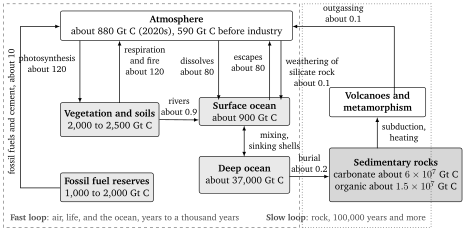
The two sizes of flux give the carbon cycle two time scales, and the unit rests on keeping them apart. The fast loop connects the air, the plants and soils, and the ocean; its fluxes are large and its reservoirs small, so a disturbance spreads through it in years to centuries, and even the deep ocean mixes with the surface in about a thousand years. The slow loop connects all of that to the rocks, and its fluxes are so small compared with the reservoirs they feed that the rocks correct a disturbance of the fast loop only over hundreds of thousands of years; Section 2 works out the number. The atmosphere matters out of all proportion to its size for two reasons: every flux of the fast loop passes through it, and its carbon dioxide sets the temperature of the surface by absorbing the heat radiation of the ground, the greenhouse effect whose discovery the excursion of Section 2 recounts. The limestone, a hundred thousand times larger, affects the climate only through the slow loop.