 Image: Donald A. Swanson (public domain)
Why Mount St Helens exploded and Kīlauea does not
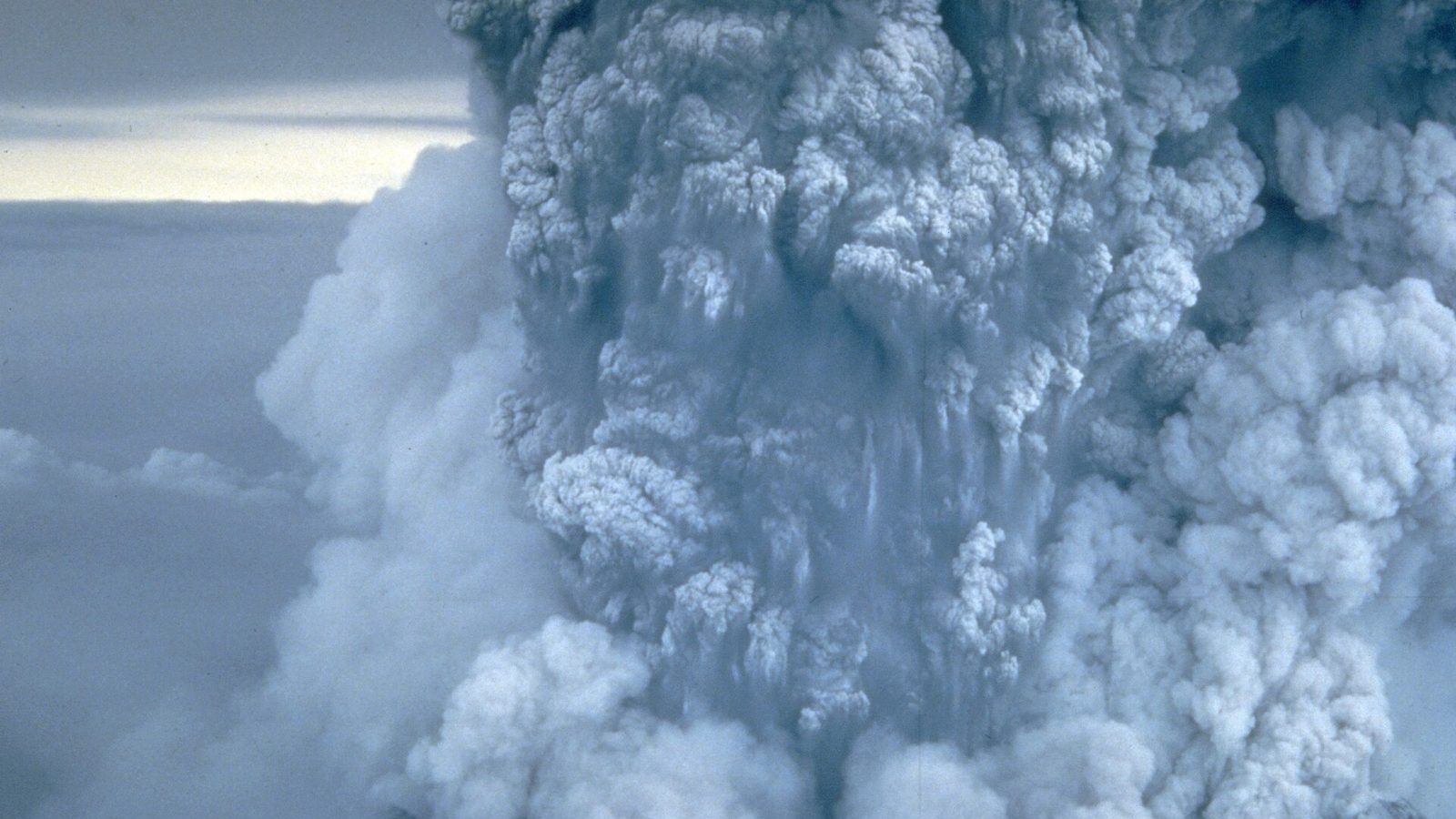
At 8:32 on the morning of 18 May 1980 a magnitude 5.1 earthquake shook Mount St Helens in Washington State, and the north face of the mountain, which had been bulging outwards at 2 m a day for two months, slid away. The landslide, 2.5 km³ of rock, was the largest in recorded history. It uncovered the magma beneath, which exploded sideways in a blast that flattened forest over 600 km² and then upwards in a column of ash 24 km high that lasted nine hours. Fifty-seven people died. The mountain lost 400 m of its summit.
Kīlauea, on the Island of Hawaiʻi, erupted almost continuously from 1983 to 2018, and in 2018 poured out about a cubic kilometre of lava in three months, destroying 700 houses. Nobody died in the lava. Tourists watch Kīlauea's eruptions from a car park. The two volcanoes are fed by magma from the mantle, and their opposite behaviour comes down to two properties of that magma: how much gas it holds and how stiff it is.
Water in the magma
Magma is not just molten rock. It carries dissolved gases, mainly water, with carbon dioxide and sulfur dioxide, in the way that a bottle of lemonade carries dissolved carbon dioxide. At the pressures of several kilometres' depth the gas stays in solution. As the magma rises and the pressure falls, the gas comes out as bubbles, and the bubbles expand. A kilogram of magma holding 4 percent water by weight releases, at atmospheric pressure, about 230 litres of steam, several hundred times the volume of the magma itself. What happens next depends on whether the bubbles can escape.
Hawaiian basalt holds about half a percent of water, because the mantle beneath a hot spot is dry. The magma that fed Mount St Helens was dacite, with about 4 to 6 percent water, because the volcano sits above a subduction zone, where the sinking Pacific plate carries sea water and wet sediment down into the mantle and the water lowers the melting point of the rock above. Subduction-zone magmas are wet magmas. That is the first half of the difference.
Silica and stiffness
The second half is viscosity, the resistance of a liquid to flowing. Basalt, with about 50 percent silica, has a viscosity at 1,150 °C of about 10 to 100 pascal-seconds, which is like honey or thick syrup. Dacite, with about 64 percent silica, at 900 °C has a viscosity of 106 to 108 pascal-seconds, a million times more, like cold pitch. The silica is the reason. In a melt the silicon and oxygen atoms link into chains and networks, and the more silica, the longer and more tangled the networks, and the harder it is for the liquid to flow. Water breaks the networks, so a wet dacite is less stiff than a dry one, but still enormously stiffer than any basalt. Unit 3 of the masterclass sets out the composition classes with their viscosities, and Unit 11 takes them into the eruption.
The fizzy drink
Open a bottle of lemonade slowly and the gas bubbles rise through the liquid and escape; the drink goes flat and stays in the bottle. Shake the bottle and open it fast and the bubbles form everywhere at once, expand faster than they can rise, and carry the liquid out of the bottle as spray. A volcano does the same. In basalt the bubbles rise through the runny liquid and burst at the surface, which is what makes the fountains and the bubbling lakes of Kīlauea; the gas gets out and the lava flows away. In dacite the bubbles cannot move through the stiff liquid. They grow where they are, the magma becomes a foam, and when the bubbles make up about three quarters of its volume the walls between them break. The foam shatters into fragments of glass and pumice, the gas expands into the open, and the mixture of gas and fragments shoots up the conduit at hundreds of metres a second. That moment is called fragmentation, and it is the explosion. The ash that fell on Washington, Idaho, and Montana on 18 May 1980 was the magma's foam, broken into pieces smaller than a sand grain.
Why the landslide mattered
The magma at St Helens had been rising since March 1980 and had pushed the north flank out by 150 m. A body of gas-charged dacite was sitting inside the mountain under the pressure of the rock above it. The landslide took that pressure off in seconds. It was the equivalent of opening the shaken bottle, and the blast that followed was directed sideways, through the hole the landslide had made, before the vertical eruption took over. The sequence was seen by two geologists, Keith and Dorothy Stoffel, from a small plane over the summit, and photographed from 11 km away by Gary Rosenquist in a series taken seconds apart, and it is the reason volcanologists now watch the shape of a volcano as closely as its earthquakes.
The worked number
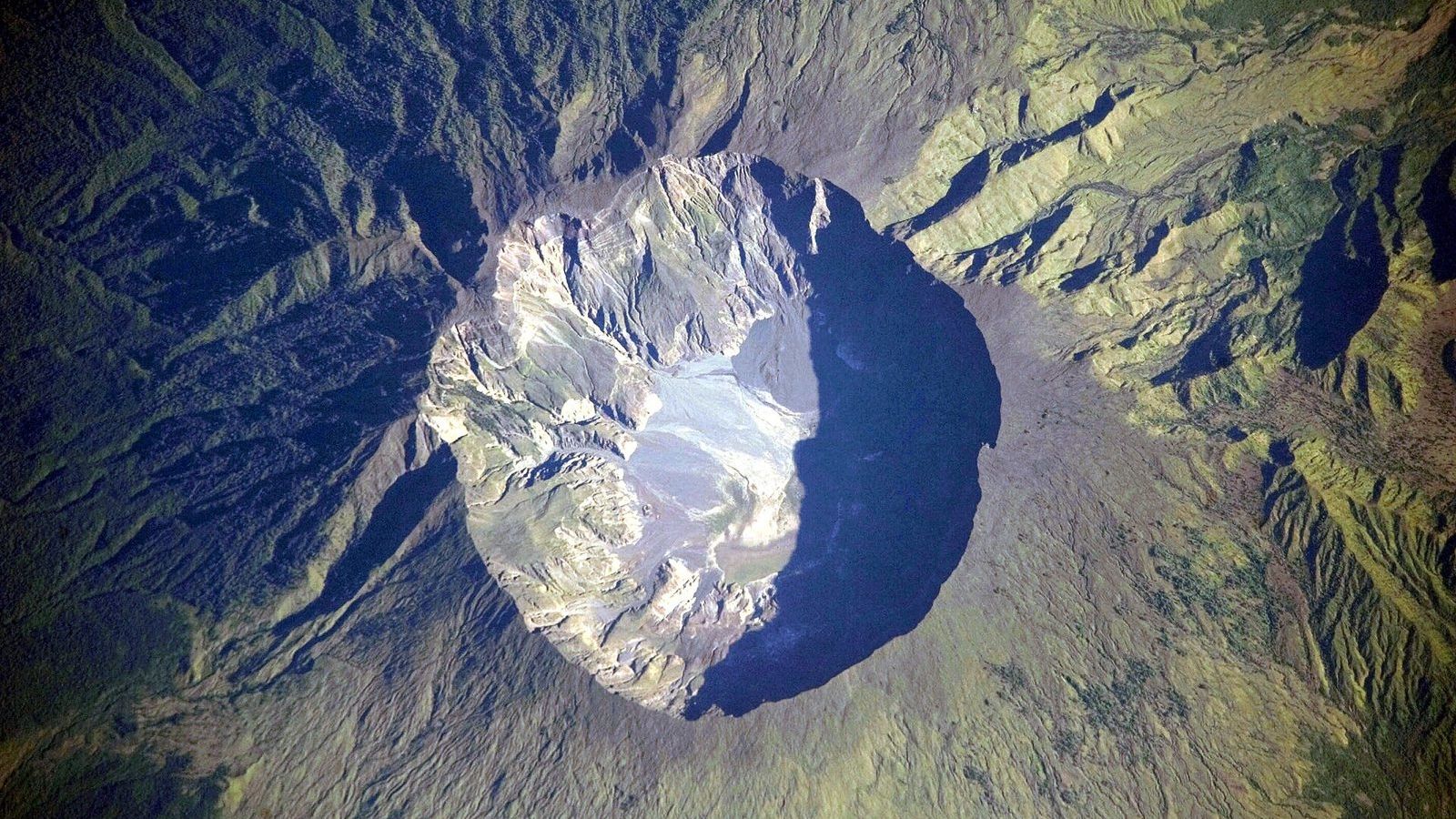
How big were the two eruptions? Volcanologists measure eruptions by the Volcanic Explosivity Index, which runs from 0 to 8 and goes up one step for every tenfold increase in the volume of material thrown out. Mount St Helens in 1980 erupted about 1 km³ of ash and pumice, which as dense rock is about 0.25 km³ of magma, and reached index 5. Kīlauea in 2018 erupted about 1 km³ of lava, a similar volume, and has an index of 0 to 1, because the lava flowed rather than exploded. The index measures violence, not volume. The 1991 eruption of Pinatubo in the Philippines, at index 6, erupted about 5 km³ of magma and cooled the planet by half a degree for two years; the 1815 eruption of Tambora, at index 7, erupted perhaps ten times that. Nothing of index 8 has happened in the last 25,000 years.
What to look for on a map
Where the volcanoes are tells you which kind they will be. Those on mid-ocean ridges and hot spots, Iceland, Hawaii, the Galápagos, the Canaries, erupt basalt and mostly pour. Those above subduction zones, the Cascades, the Andes, Japan, Indonesia, the Philippines, Italy, erupt andesite, dacite, and rhyolite and mostly explode; they are the ones with the steep cones, the pyroclastic flows, and the death tolls. The Global Volcanism Program of the Smithsonian Institution keeps the catalogue of all of them with the explosivity index of every historical eruption, and it is the masterclass's tool of the week for Unit 11. The US Geological Survey's account of the 1980 eruption, with the photographs, is at usgs.gov/volcanoes/mount-st.-helens.