Every rock began as a melt. This unit explains why the mantle melts under a ridge although it cools on the way up, what decides whether a magma becomes granite or basalt, how Bowen's reaction series lets one magma produce several rocks, and how the size of the crystals records the speed of cooling. It ends in the field, with dykes, sills, plutons, and the columns of the Giant's Causeway.
Sample unit: the complete text
Every rock on Earth began as a melt. The oldest continental crust, the floor of every ocean, and the ground under every volcano all passed through a liquid state before they became the solid rock a geologist can hold. This unit follows that history from the first drop of melt in the hot mantle to a crystal under the microscope. It explains why rock melts at all, what decides whether the melt ends up as granite or basalt, how the size of the crystals records the speed of cooling, and how to read the bodies that magma leaves behind in the field.
1 Why rock melts
Magma is molten rock below the surface. It is never a pure liquid. The melt itself is a hot liquid of silicon, oxygen, aluminium, iron, magnesium, calcium, sodium, and potassium, and it carries crystals that have already formed, fragments of the rocks it passes through, and dissolved gases, above all water vapour and carbon dioxide. When magma reaches the surface and the gases escape, the liquid that flows out is called lava. The crystals in a magma are minerals, that is, naturally formed solids with a definite chemical composition and an ordered arrangement of atoms. Almost all the minerals in this unit are silicates, which are built from the silicon-oxygen tetrahedron, a silicon atom surrounded by four oxygen atoms. Basaltic lava, the dark lava of Hawaii and Iceland, erupts at about 1,100 to 1,200 ° C, which is hot enough to glow orange in daylight. Lavas that are rich in silica, that is, in silicon dioxide, \(\mathrm{SiO_2}\), which is what the tetrahedra of a silicate add up to, are the kind that build steep volcanoes, and they are cooler, at about 700 to 900 ° C.
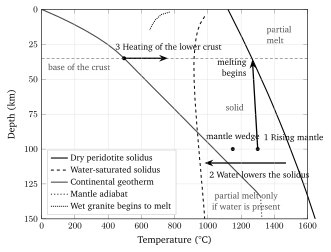
The surprising fact about melting is how rarely it happens. The temperature in the crust rises by about 25 ° C for every kilometre of depth, with a range of 15 to 30 ° C per kilometre in stable continental crust, and the deep mantle has a temperature of several thousand degrees. Yet the mantle is solid rock, and we know this because earthquake waves of a kind that cannot pass through liquids travel through it. The reason is that the melting point of rock rises with pressure, and in the mantle it rises faster than the temperature does. Two curves decide everything in this section, and Figure 1 draws them together with the three ways in which a rock can be made to cross from one to the other. The geotherm is the temperature of the rock at each depth. The solidus is the temperature at which a rock of a given composition begins to melt at each depth, and the liquidus is the higher temperature at which the last crystal disappears; between the two the rock is partly molten. The solidus in the figure is that of peridotite, the olivine-rich rock that makes up the upper mantle. Under a stable continent the geotherm stays below the solidus at every depth, and that is why continents do not sit on a sea of magma.
Figure 1. Temperature against depth in the upper mantle and crust, with the three ways to melt rock. The dry peridotite solidus is the fit of Hirschmann (2000) to melting experiments, the water-saturated solidus follows the formula of Katz, Spiegelman, and Langmuir (2003), and the continental geotherm is a steady conductive model with a surface heat flow of 60 mW per square metre, a conductivity of 3 W per metre and kelvin, and 1 \(\mu\)W per cubic metre of radioactive heat production in a 35 km crust. Below the crust the geotherm joins the mantle adiabat, the temperature curve of mantle whose temperature changes by compression and expansion alone, which would be at 1,250 ° C at the surface and warms by 0.5 ° C per kilometre of depth. Water-rich granitic crust begins to melt along the short dotted curve (the experiments of Tuttle and Bowen, 1958). Depth is converted to pressure with a density of 3,300 kg per cubic metre.
There are only three ways to bring a rock across its solidus, and each has its address on the plate map. The first is to lower the pressure. Hot mantle that rises, for example under a mid-ocean ridge where two plates pull apart, or in a hot column of mantle under Hawaii or Iceland, loses pressure far faster than it loses heat. A rising parcel cools by only about 0.5 ° C per kilometre, because expansion is the only thing that cools it (this rate of cooling by expansion alone is called the adiabatic gradient, and estimates of it run from 0.3 to 0.5 ° C per kilometre), while its solidus drops by about 4 ° C per kilometre. The parcel therefore meets its solidus on the way up and begins to melt, and this is called decompression melting. It makes most of the magma on Earth, including the basalt of the entire ocean floor. The second way is to add water. Water dissolved in a silicate melt breaks the bonds between the silicon-oxygen tetrahedra, and a wet peridotite begins to melt several hundred degrees below the dry solidus, as the dashed curve in Figure 1 shows. Above a subducting plate, the sinking plate, which geologists call the slab, heats up and releases the water it carries in its minerals, the water rises into the mantle above it, and that mantle melts although its temperature has not changed. This flux melting feeds the volcanoes of the Andes, Japan, and every other volcanic arc. The third way is to heat the rock, and it is the rarest of the three. Basaltic magma from the mantle that pools at the base of thick continental crust can raise the temperature there by several hundred degrees, and water-rich crust begins to melt at only about 650 to 700 ° C. Melting of this kind produces some of the granites of mountain belts.
A rock that crosses its solidus does not turn into liquid all at once, because a rock is a mixture of several minerals and the mixture melts over a range of temperatures. Under a mid-ocean ridge, for instance, the rising mantle melts by roughly 5 to 20 per cent before the melt escapes upward, and the rest stays solid. This is called partial melting, and it has a consequence that shapes the whole planet: the melt does not have the composition of the rock it came from. The mechanism is explained in the box below; its outcome can be stated in two sentences. Partial melting of peridotite, which contains about 45 per cent silica by mass, yields a basaltic melt with about 50 per cent silica. Partial melting of basaltic or of older continental crust yields melts with 60 to 75 per cent silica, which solidify as the rocks called diorite and granite, which Section 2 introduces, and as their volcanic equivalents. Each round of melting pushes the melt toward more silica, and this is the first of two processes (the second is in Section 3) that have sorted the Earth into a silica-poor mantle and a silica-rich continental crust.
2 The four groups by silica
Geologists sort magmas and the rocks they form by the mass fraction of silica, \(\mathrm{SiO_2}\), in a chemical analysis of the whole rock. Four groups are in use, and their boundaries are conventions agreed for convenience rather than natural breaks. A rock is called ultramafic below 45 per cent silica, mafic between 45 and 52 per cent, intermediate between 52 and 66 per cent, and felsic above 66 per cent. The words come from the chemistry: mafic rocks are rich in magnesium and iron (ferrum in Latin), felsic rocks in feldspar and silica. Table 1 lists the four groups with the properties that follow from the silica content, and the rest of this section explains why they follow. The minerals of each group are the ones that Bowen’s reaction series in Section 3 assigns to it: olivine and pyroxene in the ultramafic rocks, plagioclase and pyroxene in the mafic ones, plagioclase and amphibole in the intermediate ones, and quartz and the feldspars in the felsic ones.
Property
Ultramafic
Mafic
Intermediate
Felsic
Silica (per cent by mass)
below 45
45 to 52
52 to 66
above 66
Volcanic rock
komatiite
basalt
andesite
rhyolite
Plutonic rock
peridotite
gabbro
diorite
granite
Colour
dark green
black, dark grey
grey
pale, pink
Eruption temperature (° C)
above 1,500
1,100 to 1,200
950 to 1,050
700 to 900
Viscosity (Pa s)
below 10
10 to 100
\(10^{3}\) to \(10^{5}\)
\(10^{6}\) and above
Density (kg m\(^{-3}\))
about 3,300
about 3,000
about 2,800
about 2,700
Table 1. The four groups of igneous rocks by silica content and the properties that go with them. The boundaries are conventions. Temperatures and viscosities are typical values for melts with little water and few crystals; dissolved water lowers the viscosity by orders of magnitude, and the densities are those of the solid rocks.
The most important of these properties is the viscosity, the resistance of a liquid to flow, measured in pascal seconds. Water has a viscosity of about 0.001 Pa s and honey about 10 Pa s. In a silicate melt the silicon-oxygen tetrahedra link into chains and networks, exactly as they do in the crystals of Unit 2, and the more silica a melt contains, the more complete the network and the harder it is for the liquid to flow. A basaltic melt at 1,200 ° C has a viscosity of 10 to 100 Pa s, which is thicker than honey, and basalt still flows for tens of kilometres down a volcano. A rhyolitic melt at 800 ° C has a viscosity of a million pascal seconds or more, a hundred thousand times stiffer than honey, and such a melt piles up over its vent in a dome rather than flowing away. Two other things change the viscosity. A higher temperature makes every melt thinner, and dissolved water makes it thinner still, because the water breaks up the network of tetrahedra. Crystals suspended in the melt make it thicker, and a magma that is more than about half crystals no longer flows at all, which Section 5 comes back to.
The silica content also explains why “granite lava” hardly exists while basalt lava covers the ocean floors. A felsic magma is cool, stiff, and rich in dissolved water. It rises slowly through the crust, loses heat on the way, and usually stops and solidifies at depth as granite. When it does reach the surface, the water comes out of solution as the pressure falls, and a melt too stiff to let the bubbles escape is torn apart into ash and pumice. Felsic volcanoes therefore erupt mostly fragments, and rhyolite lava forms only short, thick flows and domes. A basaltic magma is hot, fluid, and poor in water, so its gas escapes quietly and the lava runs. The same difference in viscosity decides what an eruption looks like, which is a subject beyond the Foundation units.
Each group has its place on the map of the plates, which Unit 6 describes in full. Basalt forms wherever the mantle melts by decompression: at the mid-ocean ridges, which produce about 20 cubic kilometres of new basaltic crust every year, a cube about 2.7 km on each side, over hot spots such as Hawaii, and in the flood basalts that have covered regions the size of countries, such as the Antrim plateau of Northern Ireland in Section 5. Andesite is the typical lava of volcanic arcs above subduction zones, where the melts that added water produces in the mantle change their composition on the long way up through the crust. Granite forms in the thick crust of continental arcs and collision zones, and the great granite bodies of the Andes, the Sierra Nevada of California, and the Himalaya are all of this kind. Peridotite is the mantle itself, and it reaches the surface only in slices of ocean floor pushed onto land and in fragments carried up by basalt. Komatiite, the ultramafic lava, is almost entirely restricted to rocks older than 2,500 million years, when the mantle was hotter than today.
3 Bowen’s reaction series
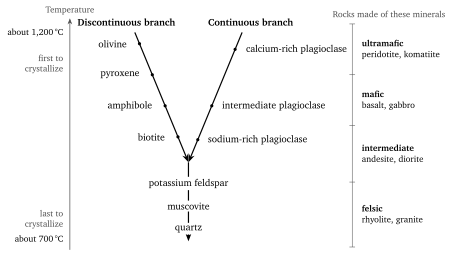
As a basaltic magma cools, its minerals appear one after another in a definite order, which was worked out between 1912 and 1928 by Norman L. Bowen (1887-1956), as the excursion below tells. Figure 2 shows the result, which every geologist knows as Bowen’s reaction series.
Figure 2. Bowen’s reaction series. On the discontinuous branch each mineral reacts with the remaining melt to form the next one as the temperature falls; on the continuous branch plagioclase keeps its structure and changes its composition from calcium-rich to sodium-rich. The two branches meet, and potassium feldspar, muscovite, and quartz crystallize last. The temperatures are approximate and depend on pressure and water content. Drawn after Bowen (1922, 1928).
The series has two branches that run at the same time. On the discontinuous branch, the first mineral to crystallize from a basaltic melt is olivine. As the temperature falls, the olivine crystals react with the melt around them and are converted into pyroxene, the pyroxene later reacts to form amphibole, and the amphibole reacts to form biotite. Each of these is a different mineral with a different structure, which is why the branch is called discontinuous. On the continuous branch, plagioclase feldspar crystallizes from beginning to end, but its composition changes. The first plagioclase is rich in calcium, and as the melt cools the crystals react with it and take up more and more sodium, so that a single crystal that grew during cooling has a calcium-rich centre and a sodium-rich rim. Plagioclase is a solid solution between a calcium end member and a sodium end member, as Unit 2 explained for olivine. The two branches meet when the melt has cooled to roughly 800 ° C, and the last minerals to crystallize, from a melt that is now rich in silica, potassium, and water, are potassium feldspar, muscovite, and quartz.
The series explains at once why a basalt contains olivine, pyroxene, and calcium-rich plagioclase and hardly ever quartz, while a granite contains quartz, potassium feldspar, sodium-rich plagioclase, and a little biotite and hardly ever olivine (the exceptions, such as the little quartz in some sills of dolerite, the medium-grained basalt of sills and dykes, come from the last drops of melt or from unusual compositions). Minerals that crystallize at similar temperatures occur together, and minerals from opposite ends of the series do not. It also explains a second thing, which Bowen regarded as his main result. If the early crystals are removed from the melt, the melt that remains has a new composition, poorer in magnesium, iron, and calcium and richer in silica, sodium, and potassium than the magma it started as. Crystals are removed when they sink to the floor of a magma body because they are denser than the melt, when they are left behind on the walls, or when the melt is squeezed out of a mass of crystals. This process is called fractional crystallization, and the sorting of a magma into parts of different composition is called differentiation. A single parent basalt can in this way produce a gabbro from its first crystals, then a diorite, and finally a small amount of granite from its last melt, and the layered intrusions of the world, where the sunken crystals lie in beds like sediments, are the record of it. Two other processes change a magma on its way up: it can melt and dissolve the rocks it passes through, which is called assimilation, and two magmas can mix.
4 Textures and the names of igneous rocks
The size and arrangement of the crystals in an igneous rock are called its texture, and texture is a record of how fast the melt cooled. The box below explains why, and the rule it gives is worth stating first: the slower the cooling, the larger the crystals. Geologists describe igneous textures with a handful of words.
A glassy rock has no crystals at all, because the melt cooled too quickly for any to form. Obsidian is a felsic glass, and the dark crust of a basalt flow is glass a few millimetres thick.
An aphanitic rock is made of crystals too small to see without a lens, smaller than about a millimetre. This is the texture of lava flows and of thin dykes and sills, which cool in hours to years.
A phaneritic rock is made of crystals large enough to see with the unaided eye, from about a millimetre to a few centimetres, all of roughly similar size and interlocking. This is the texture of rocks that cooled slowly at depth over thousands of years.
A porphyritic rock has large crystals, called phenocrysts, set in a finer groundmass. It records two steps of cooling: a slow one at depth, during which the phenocrysts grew, and a fast one when the magma rose or erupted and the groundmass froze around them.
A pegmatitic rock has crystals larger than a few centimetres, sometimes metres long. Pegmatites form from the last, water-rich melt of a granite, in which atoms move fast enough to build giant crystals.
A vesicular rock is full of small cavities left by gas bubbles that were frozen into the lava. Pumice is so full of them that it floats.
A pyroclastic rock is made of fragments thrown out by an explosive eruption, from ash to blocks, that settled and were welded or cemented together. Tuff is the common name.
How long a body of magma takes to solidify can be estimated from a single rule of heat conduction. Heat travels through rock by conduction, and the time \(t\) it takes to pass through a thickness \(d\) is
\begin{equation}
t \approx \frac{d^{2}}{\kappa} , \label{eq:cool}
\end{equation}
where \(\kappa\) (kappa) is the thermal diffusivity of rock, a measure of how fast heat spreads through it, about \(10^{-6}\unit{m^{2}\,s^{-1}}\). A thickness in metres, squared and divided by this number, gives a time in seconds, and the value of \(\kappa\) means that heat needs about \(10^{6}\) seconds, roughly twelve days, to pass through one metre of rock. The time grows with the square of the size, so a body ten times thicker takes a hundred times longer to cool, and this is why the cooling times of igneous bodies span from hours to a million years.
Figure 3. A thin section of the Woodbury Granite from near Barre, Vermont, in cross-polarized light. The grey and white crystals with no stripes are quartz, the striped grey crystals are plagioclase, whose stripes are twinning, two orientations of the same crystal grown together, the brown crystals are biotite, and the bright pink and green crystal is muscovite. The photographer gives no scale; Dale (1909) measured the feldspars of this granite at about 2.7 mm across on average, which gives the scale of the picture. Credit: Darla Sondrol, Geoscience Digital Image Library, CC0.Figure 4. A thin section of an olivine basalt in cross-polarized light, 2 mm across. The large bright crystal is an olivine phenocryst, its shape complete because it grew freely in the melt at depth, and the groundmass around it is a mass of plagioclase laths and pyroxene too small to see without a microscope, which froze when the lava erupted. Credit: Strekeisen, Wikimedia Commons, CC BY-SA 4.0.
Figures 3 and 4 show the two commonest igneous rocks under the polarizing microscope of Unit 2, in slices ground to a thickness of 0.03 mm so that light passes through the crystals. In the granite every crystal is a millimetre or more across and the crystals interlock without any gaps, which is the phaneritic texture of a melt that cooled over thousands of years underground. In the basalt a single large olivine crystal sits in a groundmass of crystals a hundredth of its size, which is the porphyritic texture of a lava that carried its early crystals to the surface and then froze within days.
Texture and composition together give an igneous rock its name, and Table 2 is the grid that geologists use. The columns are the four silica groups of Section 2, and the rows are the two textures, so that each column holds a pair of rocks of the same composition: a fine-grained volcanic rock that cooled at the surface and a coarse-grained plutonic rock that cooled at depth. Basalt and gabbro are chemically the same rock, and so are andesite and diorite, and rhyolite and granite. The names in the table are the ones in everyday use; the full scheme of the International Union of Geological Sciences names plutonic rocks by the proportions of quartz, alkali feldspar (the group to which the potassium feldspar of Bowen’s series belongs), and plagioclase in a triangular diagram, and granite is one of its fields, as the last worked example of this section shows.
Texture
Ultramafic
Mafic
Intermediate
Felsic
Aphanitic (volcanic)
komatiite
basalt
andesite
rhyolite
Phaneritic (plutonic)
peridotite
gabbro
diorite
granite
Glassy
(none)
basaltic glass
(rare)
obsidian
Pyroclastic
(none)
basaltic tuff
andesitic tuff
rhyolitic tuff
Silica (per cent)
below 45
45 to 52
52 to 66
above 66
Dark minerals (per cent)
above 70
about 40 to 70
about 20 to 40
below 20
Table 2. The classification grid of the common igneous rocks. A rock is named from its silica group (columns) and its texture (rows). Dolerite, also called diabase, is the medium-grained basalt of dykes and sills, and the proportions of dark minerals are typical values rather than definitions.
5 Intrusions and their field relations
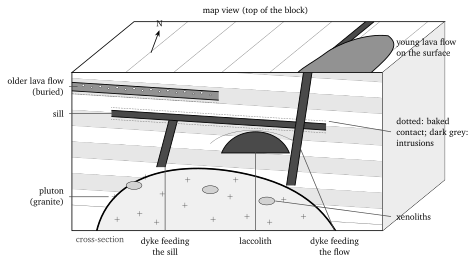
Magma that solidifies below the surface forms an intrusion, and the rocks it invades are called the country rock. Intrusions come in a few shapes, which Figure 5 draws together, and the shapes are named by their relation to the layers of the country rock. A dyke is a sheet of igneous rock that cuts across the layering, usually steep, from centimetres to tens of metres thick and sometimes hundreds of kilometres long; dykes are the cracks through which magma rose. A sill is a sheet that was injected between the layers and lies parallel to them. A laccolith is a sill that grew thick enough in the middle to dome the layers above it into a lens. A pluton is any large body of coarse-grained igneous rock, and a batholith is a pluton, or a cluster of plutons, that is exposed over more than 100 square kilometres; the Sierra Nevada batholith of California is 600 km long, and a pluton exposed over a smaller area is called a stock. Plutons are the frozen magma reservoirs of former volcanic regions, exposed after the kilometres of rock above them were eroded away.
Figure 5. Intrusive bodies and lava flows in a block diagram, schematic and not to scale. The front face is a cross-section, the top face the map of the same ground. A pluton of granite with xenoliths of the country rock feeds two dykes. One ends in a sill that follows the bedding, the other reaches the surface and feeds a young lava flow; a laccolith domes the beds above it. An older lava flow, now buried, has a baked zone only beneath it and gas bubbles at its top. On the map the dyke appears as a straight band crossing the beds, while the sill is hidden.
Three features of an intrusion can be read in an outcrop. The first is the chilled margin, a rim of fine-grained or glassy rock a few centimetres thick along the edge of a dyke or sill, where the magma froze fast against cold country rock while the interior cooled slowly and grew larger crystals. The second is the baked contact, a zone of country rock next to the intrusion that was hardened and recrystallized by its heat, the beginning of the contact metamorphism of Unit 5. The third feature consists of xenoliths, fragments of country rock torn off the walls and frozen into the magma, from a few centimetres to the size of a house. All three say the same thing about age: the intrusion is younger than the rock it chills, bakes, or carries as fragments. This is the principle of cross-cutting relationships of Unit 1, which states that a body of rock that cuts across another is the younger of the two, and its companion, the law of included fragments, which states that a rock that contains fragments of another is younger than the rock the fragments came from. In Figure 5 the dykes cut the beds and the sill, so they are younger than both, and the pluton holds fragments of the beds, so it is younger than the beds.
The same features separate a sill from a buried lava flow, which can look alike in a cliff, since both are sheets of fine-grained basalt lying between sedimentary beds. A sill was injected into beds that already existed on both sides, so it has chilled margins and baked contacts above and below, and the beds above it are baked. A lava flow poured out over the ground, so it bakes only the beds beneath it, and the beds above were laid down later on its cold top. The top of a flow is full of frozen gas bubbles and often rubbly or weathered, and the sediment laid on it may contain fragments broken from that top, whereas a sill is dense from top to bottom and may contain xenoliths of its roof. On a geological map a dyke appears as a straight band that cuts across the outcrop pattern of the beds, because it is a steep sheet that the ground surface cuts through, while a sill appears as a band that follows the beds exactly and can be mistaken for one of them.
Shallow intrusions and thick lava flows share one more feature that any visitor to Northern Ireland can see. When a sheet of basalt cools from its two surfaces inward, it contracts, and the contraction sets up a tension that the rock relieves by cracking. The cracks begin at the cooling surfaces and advance into the sheet, step by step, as the cooling front moves inward, and they organize themselves into a network of polygons, because a network of three cracks meeting at angles of 120 degrees relieves the tension with the least total length of crack. The result is columnar jointing, a mass of polygonal columns standing at right angles to the cooling surfaces, most of them with five or six sides. Figure 6 shows the most famous example. The columns are not crystals, and the hexagons have nothing to do with the atomic structure of the rock; they are the same pattern as the cracks in drying mud, scaled up. Experiments on basalt from Iceland by Lamur and colleagues, published in 2018, showed that the cracks form at 840 to 890 ° C, well below the temperature at which the lava finished crystallizing, so a column is already solid rock when it breaks from its neighbours. Slower cooling makes wider columns, because the tension builds up more gradually and fewer, more widely spaced cracks are enough to relieve it, which is why the columns of a thick flow are half a metre across while those in a thin dyke may be a few centimetres.
Figure 6. The Giant’s Causeway on the coast of County Antrim, Northern Ireland, where about 40,000 basalt columns stand in a lava flow of the Antrim plateau that erupted in the Paleocene epoch, about 60 to 55 million years ago. The columns are about half a metre across and mostly six-sided; the visitors at the left give the scale. Credit: Ajay Suresh, Wikimedia Commons, CC BY 2.0.
The textbook picture of the reservoir under a volcano has long been a cavern of liquid, the magma chamber, which empties in an eruption and finally freezes into a pluton, but that picture has changed. Geophysical surveys under active volcanoes rarely find large bodies of liquid; they find zones of partly molten rock, a few per cent to perhaps a quarter melt, that extend through much of the crust. Petrologists find that the crystals in a single lava have different origins and ages, and that some of them grew tens of thousands of years before the eruption that carried them up. The picture that fits these findings is a crystal mush, a framework of crystals with melt in the spaces between them, which cannot erupt as it is because it is too stiff, until melt is squeezed out of it and gathers into a lens that can. The research spotlight presents the review that drew this picture together; a pluton, in this view, is a frozen mush column.
This is one of 16 units
Participants also get the quiz, the further reading, and the final exam.