

Volcanoes and Magmatic Systems
Kīlauea pours out lava for months while Mount St Helens blew its summit off in minutes, and the difference lies in two properties of the magma: the water it carries and the stiffness of its melt. This unit follows magma from a crystal mush to the vent, computes where its water begins to bubble and where the magma fragments, sorts eruptions by style and size, explains how an eruption column rises into the stratosphere, and shows how earthquakes, ground deformation, and gas gave the forecast that moved 60,000 people away from Pinatubo in 1991 and why 1816 had no summer.
On 18 May 1980 Mount St Helens in the state of Washington lost its upper 400 m in a few minutes and sent ash across the United States, and in 2018 Kīlauea in Hawaii poured out 0.8 cubic kilometres of lava over three months without a single large explosion. Both volcanoes are fed by magma, and the difference between them is decided by two properties of that magma, which are the gas it carries and the stiffness of its melt. This unit follows magma from its storage in the crust to the vent, explains why dissolved water turns a quiet lava into a column of ash 35 km high, sorts eruptions by style and size, and shows how the signals a volcano gives off before it erupts have been read in time to move tens of thousands of people out of the way.
1 The plumbing beneath a volcano
Unit 3 replaced the cavern of liquid under a volcano with a crystal mush, a column of crystals with melt in the spaces between them that reaches through much of the crust and is too stiff to erupt as it is. Melt is squeezed out of the mush in episodes and gathers in lenses, pockets of melt that are wide and thin like a lens, and a shallow lens of this kind, a few kilometres below the surface, is the reservoir that feeds most eruptions. Figure 1 draws the whole system. Everything in this unit happens between that reservoir and the air above the vent.
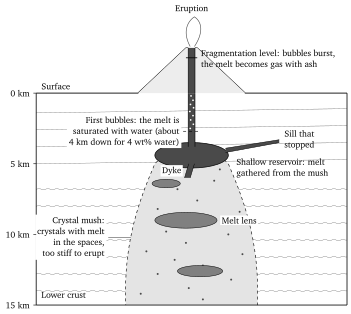
Magma rises because it is lighter than the rock around it. A basaltic melt has a density of about 2,650 kg per cubic metre and a rhyolitic melt about 2,350, while the crust they rise through has 2,700 to 3,000 kg per cubic metre, so the melt is buoyant like oil in water. The buoyancy is not large. The pressure that a column of liquid exerts is its density times \(g\) times its height, so a density difference of about 300 kg per cubic metre amounts to \(300\times9.81\times1{,}000 \approx 3\times10^{6}\) Pa, which is 3 MPa, for each kilometre of magma column, and a column 10 km high pushes on its top with about 30 MPa, some 300 times atmospheric pressure and several times the strength of rock in tension, that is, when it is pulled apart. That is enough to split the rock, and magma therefore travels through the crust in dykes, thin sheets of melt a metre or a few metres wide that force a crack open ahead of themselves and can run for tens of kilometres sideways and upward. A dyke that reaches the surface opens a fissure, as the dyke under the lower East Rift Zone of Kīlauea did on 3 May 2018, when fissures opened through a housing estate; a dyke that stops short of the surface solidifies into the sheet of igneous rock that Unit 3 called a dyke. Where the same path is used again and again, a pipe-like conduit develops below the vent, and a volcano with a conduit can erupt from one place for centuries.
Two things change as the magma rises. The pressure on it falls, because the pressure at a depth \(z\) is the weight of the rock above, \(P = \rho g z\), and with a rock density of 2,700 kg per cubic metre that is about 27 MPa for every kilometre. As the pressure falls, the gases dissolved in the melt, which were held in solution by that pressure, begin to come out of solution, which volcanologists call exsolving. This second change is the subject of the next section, and it decides whether the magma arrives at the surface as a flow or as an explosion.