 Image: Ajay Suresh (CC BY 2.0)
Why basalt is dark and granite is light
Pick up a piece of basalt and a piece of granite. The basalt is dark grey to black, heavy for its size, and fine-grained, often with small holes where gas bubbles were. The granite is pale, pink or grey or white, lighter, and made of crystals you can see: glassy quartz, blocky feldspar, and flakes of black or silver mica. Basalt makes the floors of all the oceans, the Giant's Causeway, Iceland, and Hawaii. Granite makes the cores of the continents, Yosemite, Dartmoor, and most kitchen worktops. Both solidified from magma. Why are they so different?
Silica, iron, and magnesium
The first answer is chemistry. The main ingredient of nearly every igneous rock is silica, SiO2, counted as a percentage of the rock's weight. Basalt has about 45 to 52 percent silica; granite has about 70 percent or more. The rest is mostly oxides of aluminium, iron, magnesium, calcium, sodium, and potassium, and the balance between them changes with the silica. A basalt is rich in iron and magnesium, which go into dark minerals: olivine, pyroxene, and a calcium-rich plagioclase feldspar. A granite is poor in iron and magnesium and rich in potassium and sodium, which go into pale minerals: quartz, potassium feldspar, and sodium-rich plagioclase, with only a little dark mica or amphibole. Geologists call the iron-and-magnesium-rich rocks mafic and the silica-rich rocks felsic, from feldspar and silica, and the colour follows the chemistry almost without exception.
The density follows too. Basalt is about 3,000 kg/m³, granite about 2,700 kg/m³. That difference of 10 percent is the reason continents stand above the oceans: continental crust, which is granitic on average, floats higher on the mantle than oceanic crust, which is basaltic. Unit 3 of the masterclass uses these two densities throughout.
Grain size
The second difference, the size of the crystals, has nothing to do with chemistry and everything to do with cooling. Basalt is fine-grained because it erupted at the surface as lava and cooled in days or weeks, too fast for crystals to grow large. Granite is coarse-grained because it crystallized several kilometres underground, in a body of magma that took tens of thousands of years to cool. A basaltic magma that cools slowly underground makes gabbro, a coarse dark rock with the same chemistry as basalt. A granitic magma that erupts at the surface makes rhyolite, a pale fine-grained rock with the same chemistry as granite. So there are really two questions in one: why are the chemistries different, and why does the same chemistry come in two textures. The texture is the easy one.
Where basalt comes from
Basalt is what you get when the Earth's mantle melts. The mantle is peridotite, a rock made of olivine and pyroxene with about 45 percent silica, and it is solid, though hot, almost everywhere. It melts where it rises and the pressure on it drops, under a mid-ocean ridge or a hot spot, or where water from a sinking plate lowers its melting point, above a subduction zone. It never melts completely. Typically 5 to 20 percent of the rock melts, and the melt that separates from the remaining solid is not the same composition as the whole rock. The first melt is richer in silica, aluminium, calcium, and sodium than the peridotite it came from, and poorer in magnesium. That first melt is basalt. Partial melting is the key idea: melting a rock partly gives a liquid of a different composition from the rock, always shifted towards more silica.
Bowen's series
Norman L. Bowen (1887 to 1956), a Canadian working at the Geophysical Laboratory in Washington, spent the 1910s and 1920s melting rock powders in furnaces and cooling them slowly to see which minerals crystallized first. His result, published in full in 1928 and known as Bowen's reaction series, is the second half of the answer. From a basaltic melt, the first mineral to crystallize is olivine, at about 1,200 °C, followed by pyroxene, then amphibole, then biotite mica; at the same time, calcium-rich plagioclase crystallizes first and becomes steadily richer in sodium as the temperature falls. Quartz and potassium feldspar come last, below about 800 °C.
Now suppose the early crystals are removed from the melt. Olivine is dense and sinks to the floor of the magma chamber; or the melt is squeezed out of a crystal mush and moves upward, leaving the crystals behind. Either way the remaining liquid has lost iron and magnesium and kept its silica, so it has become more felsic. Keep removing crystals as the magma cools and the last liquid is a small volume of granitic composition. This process is fractional crystallization, and it means that one mantle-derived basaltic magma can, in principle, produce a little granite at the end. In practice most of the granite of the continents is made another way, by partial melting of older continental crust, itself the product of earlier cycles, when it is heated during mountain building or by basalt intruding beneath it. The continents have become more granitic over four billion years by repeating the step.
The worked number
How much granite can a basalt make? Suppose 100 kg of basaltic magma with 50 percent silica crystallizes olivine and pyroxene, which together have about 45 percent silica, until 80 kg of crystals have been removed. The silica removed is 0.45 × 80 = 36 kg. The silica remaining is 50 − 36 = 14 kg, in 20 kg of liquid, so the liquid is 14/20 = 70 percent silica, which is granitic. The real sequence removes plagioclase too and runs through intermediate compositions on the way, which is how andesite and diorite arise, but the arithmetic shows the principle: removing 80 percent of a basalt as dark crystals leaves 20 percent as a pale, silica-rich melt.
Look at the Causeway
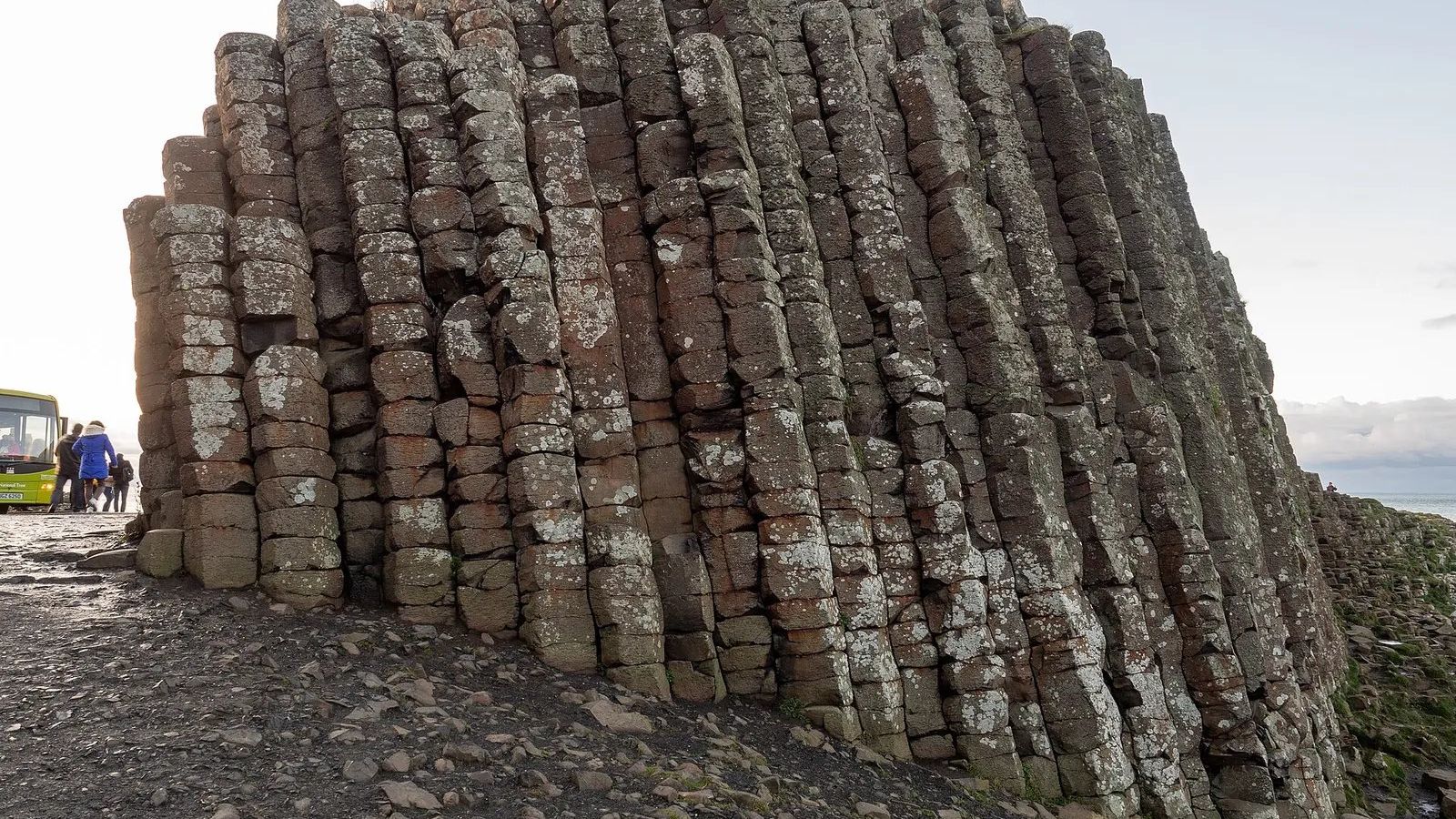
The basalt columns of the Giant's Causeway in Northern Ireland, in the picture, formed about 60 million years ago when the North Atlantic began to open and basalt flooded across what is now Antrim. The columns are a cooling feature: a thick lava flow contracted as it cooled and cracked into polygons, mostly hexagons, that run down through the flow at right angles to the cooling surfaces. The same columns can be seen at Staffa in Scotland, the Devils Postpile in California, and in many road cuttings through old lava. The pale granite of the same age, from the same magmatic event, is found at the Mourne Mountains, 80 km to the south, where the fractionated and crust-melted liquid cooled underground. Both rocks came from the same episode of mantle melting, and the masterclass explains in Unit 3 how to read the whole story from the minerals in a thin section.
The Open University's Virtual Microscope has thin sections of both rocks that you can rotate under crossed polarizers in your browser, and it is the tool of the week for Unit 3.