

Earthquakes and the Deep Earth
An earthquake is the sudden slip of a fault that the plates had bent for centuries, and the waves it sends out carry two kinds of information: where and how large the earthquake was, and what the Earth is made of along the way. This unit follows the waves from the fault to the seismometer and then through the planet, from Reid's elastic rebound and the S minus P rule to the moment magnitude, the map of deep earthquakes, the shadow zones that revealed the core, and the layers, materials, and temperatures of the Earth down to its centre.
At 11:56 in the morning of 25 April 2015, a fault beneath the hills of central Nepal slipped by several metres over a patch about 150 km long, and the shaking that followed killed nearly 9,000 people. The slip itself took about a minute, but the strain it released had been stored for centuries, because India pushes north under Tibet at about 4 cm per year (Unit 7), and the waves the slip sent out were recorded within half an hour on every continent. This unit explains what happens on a fault in those seconds, how the waves are read to find where and how large an earthquake was, and how the same waves, crossing the whole planet, revealed the layers of the Earth thousands of kilometres below the deepest borehole.
1 What happens on a fault
An earthquake is the shaking produced when rock on the two sides of a fault slides suddenly past each other. The point inside the Earth where the sliding begins is the focus (also called the hypocentre), and the point on the surface directly above it is the epicentre. The sliding does not happen everywhere at once. It starts at the focus and spreads across the fault surface at 2 to 3 km per second, about ten times as fast as a passenger jet flies, so a rupture 150 km long, like that of 2015, takes about a minute to complete, and a rupture 500 km long takes a few minutes. The part of the fault that slips is called the rupture, and its length, width, and amount of slip decide how large the earthquake is (Section 3).
The energy for all this is stored beforehand in the rock itself. A fault that is pushed by the slow motion of the plates (Unit 6) does not slide steadily, because friction holds its two sides together. A fault that is held together by friction in this way is called locked. The rock on either side of it bends instead, like a wooden stick that is bent slowly by a growing weight, and the bending is elastic, which means that the rock would spring back if the weight were removed. Over decades and centuries the bending grows until the stress on the fault exceeds the friction that holds it, and then the fault slips, the rock on both sides snaps back to its unbent shape, and the stored elastic energy leaves as heat, as crushed rock, and as the seismic waves that shake the ground. This is the theory of elastic rebound, which Harry Fielding Reid (1859-1944) worked out after the 1906 San Francisco earthquake, and Figure 1 shows it in three frames.
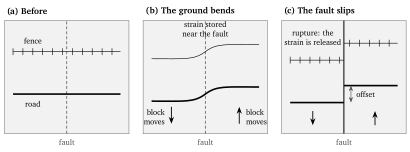
The alternation of slow loading and sudden slip is called stick-slip behaviour, and it is the same behaviour that makes a door hinge creak or a violin string sing under the bow. Its consequence for a fault is the seismic cycle. Between earthquakes the fault is locked and strain accumulates at the rate at which the plates move, in the earthquake the strain is released, and afterwards the fault adjusts for months to years. During this adjustment the fault produces aftershocks, smaller earthquakes on and around the rupture, and their rate falls roughly as the inverse of the time since the main shock, so that ten days after the main shock there are about a tenth as many per day as there were one day after it; this rule was found by Fusakichi Omori (1868-1923) in 1894 and is known as Omori’s law. For example, the Pacific plate slides past North America along the San Andreas Fault at about 3.5 cm per year, and the 1906 earthquake offset the ground by up to about 6 m, so the strain released in 1906 had taken roughly 170 years to accumulate if the fault was fully locked, because 6 m divided by 3.5 cm per year is about 170 years. The cycle is only roughly regular, because faults interact, slip is uneven along a rupture, and some faults creep slowly without large earthquakes at all, which is why the recurrence interval of a fault, the typical time between its large earthquakes, is always quoted as a range.