 Image: James St. John (CC BY 2.0)
How slate, schist, and gneiss are the same rock
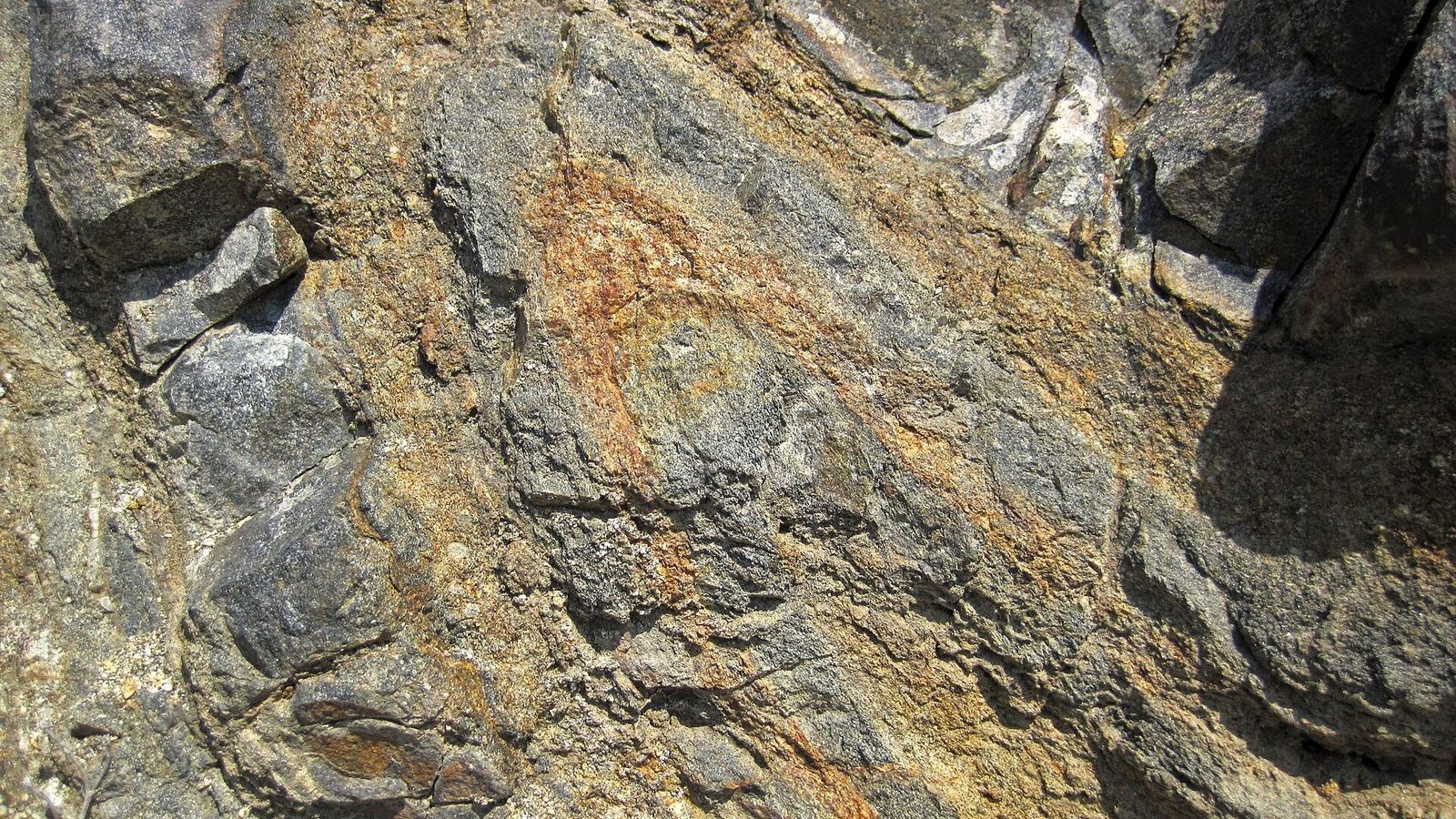
A roofing slate, a glittering schist with garnets in it, and a banded gneiss like the one in the photograph look like three different rocks, and in the hand they are. Chemically they can be the same rock. All three can be made from one starting material, a mudstone, by burying it to increasing depth, and the sequence they form is the clearest example in geology of how a rock records the temperature and pressure it has been through. The rocks are said to differ in metamorphic grade, and reading grade is the subject of Unit 5 of the masterclass.
Starting with mud
Mud is clay minerals, quartz silt, and water, deposited in a lake, a delta, or the sea. Buried under a few hundred metres of later sediment, it loses most of its water and becomes mudstone or shale, which splits along the bedding. Nothing has yet recrystallized. The clay minerals are stable at the surface, and they are unstable above about 200 °C, which, with a geothermal gradient of 25 °C per km, is reached at about 8 km of burial. Metamorphism begins there.
Slate
At around 200 to 300 °C and under a squeeze from the side, as happens in a growing mountain belt, the clay minerals break down and tiny flakes of mica and chlorite grow in their place. The flakes grow with their flat faces at right angles to the squeezing, which is usually not parallel to the bedding, and the rock acquires a new plane of splitting, the slaty cleavage, that cuts across the old beds. That cleavage is why slate makes roofs: it splits into thin sheets along a surface that the geologist made in a mountain belt, not the sedimentary one. The grains are still too small to see, and the rock is dull. Welsh slate was metamorphosed in the Caledonian mountain building about 400 million years ago, and the bedding can often still be seen on a roof slate as faint stripes at an angle to the split surface.
Schist
Between about 300 and 600 °C the micas grow large enough to see and the rock sparkles; it is now a schist, and the splitting surface is called schistosity. New minerals appear that were not in the slate, each at a definite temperature: biotite, the black mica, then garnet, the red crystals that stud the garnet mica schists of Syros in Greece, then staurolite and kyanite. These are index minerals, and they are the thermometer. A garnet grows when the rock reaches about 450 °C, and once grown it does not go away on cooling, so a garnet schist has been at 450 °C at least. Pressure leaves a signature too: kyanite forms at high pressure and andalusite at low, from the same composition, so a schist with kyanite was deep and a schist with andalusite was shallow and hot, close to a granite, for example.
Gneiss
Above about 600 °C the micas themselves begin to break down and the rock separates into bands: pale bands of quartz and feldspar and dark bands of biotite and amphibole, each a few millimetres to centimetres thick. The banded rock is gneiss, and the mineral that marks its onset in a rock of mudstone composition is sillimanite. By about 700 °C, with water present, the pale bands start to melt, and the partly melted rock is a migmatite, in which veins of granite thread through the gneiss. Go further and the rock is a granite magma; the cycle has come round, and the sediment has become an igneous rock. The photograph shows Archean gneiss in Montana folded while hot and plastic, which gneiss at 700 °C and 20 km depth is.
Barrow's walk
The sequence was first mapped by George Barrow (1853 to 1932), a surveyor of the Geological Survey of Great Britain, in Glen Esk and the neighbouring glens of the south-east Highlands of Scotland in the 1890s. The rocks there are the Dalradian, a thick pile of Precambrian sediments metamorphosed in the Caledonian mountain building. Walking north-west up Glen Esk from the Highland Boundary Fault, Barrow found the same original mudstones passing from slate through schist to gneiss, and he drew lines on the map where each new mineral first appeared: chlorite, biotite, garnet, staurolite, kyanite, sillimanite. He published the zones in 1893 and refined them in 1912, and they are still called Barrow's zones, and the line where an index mineral first appears is still called an isograd. The whole walk is about 15 km, and the temperature it records rises from about 300 to over 650 °C.
Barrow's zones are a thermometer, but not every mountain belt reads the same. In the Buchan district of north-east Scotland, Barrow's contemporaries found andalusite and cordierite where he had kyanite and staurolite, which means lower pressure at the same temperature: the Buchan rocks were heated at shallower depth. Pentti Eskola (1883 to 1964) in Finland generalized the idea in 1915 into metamorphic facies, sets of minerals that define a range of pressure and temperature whatever the rock's composition, and the facies diagram is how metamorphism is taught today.
The worked number
How deep was the gneiss? Lithostatic pressure is the weight of the overlying rock, P = ρgz, with ρ the density of the crust, about 2,700 kg/m³, g = 9.81 m/s², and z the depth. That gives 26.5 megapascals per kilometre, or close to 1 gigapascal at 35 to 38 km. A kyanite-sillimanite gneiss whose minerals record 700 °C and 0.7 gigapascals formed at about 26 km, in the middle of a crust thickened to 60 or 70 km by a continental collision, like the crust under the Himalaya today. Its geothermal gradient at the time was 700 °C over 26 km, about 27 °C per km, which is normal. A rock like the Syros schist, with glaucophane, a blue amphibole that forms only at high pressure and low temperature, records perhaps 500 °C and 1.5 gigapascals, which is 55 km deep at a gradient of only 9 °C per km; that is the signature of a subduction zone, where cold ocean crust is pushed down fast. Minerals are pressure gauges as much as thermometers, and a geologist who reads them can tell a collision from a subduction zone from a single hand specimen.
The Dalradian rocks of Glen Esk can be followed on the BGS Geology Viewer, where the formation descriptions name the index minerals, and it is the masterclass's tool of the week for Unit 5. Barrow's 1893 paper, "On an intrusion of muscovite-biotite gneiss in the south-eastern Highlands of Scotland, and its accompanying metamorphism", is in the Quarterly Journal of the Geological Society and is listed at doi.org/10.1144/GSL.JGS.1893.049.01-04.52.