 Image: Arito Sakaguchi & IODP/TAMU (Attribution)
The last time the planet released this much carbon
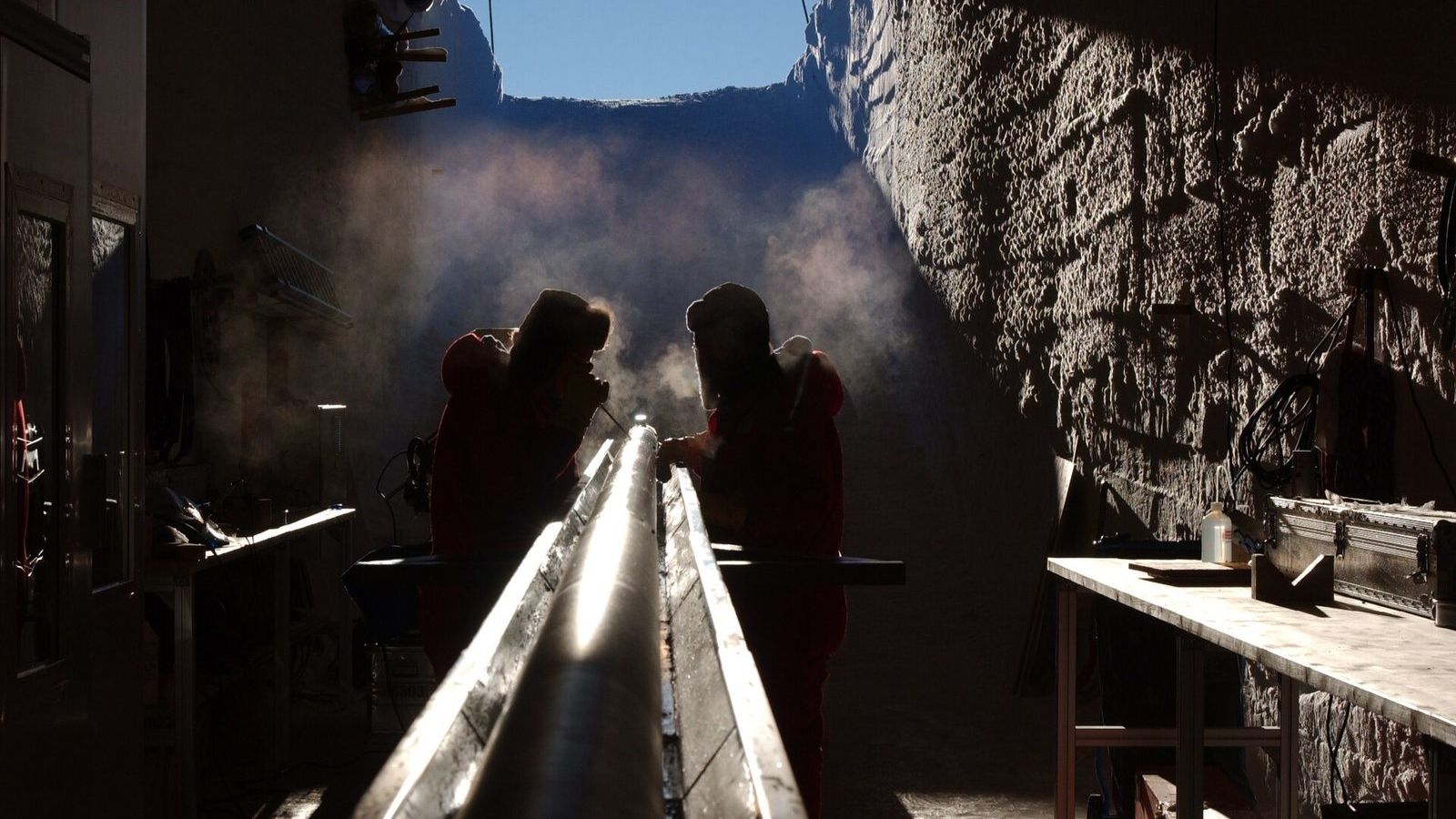
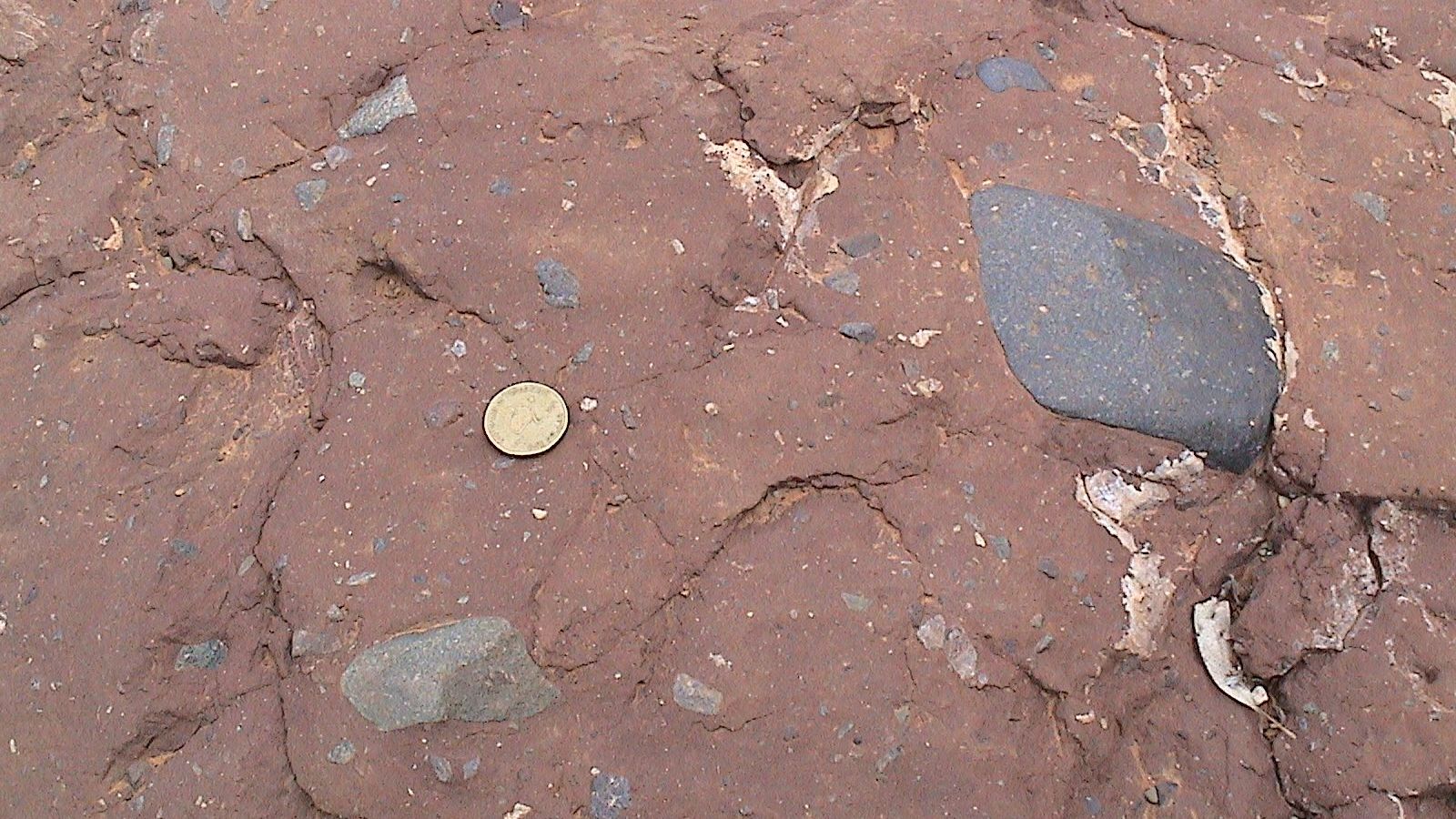
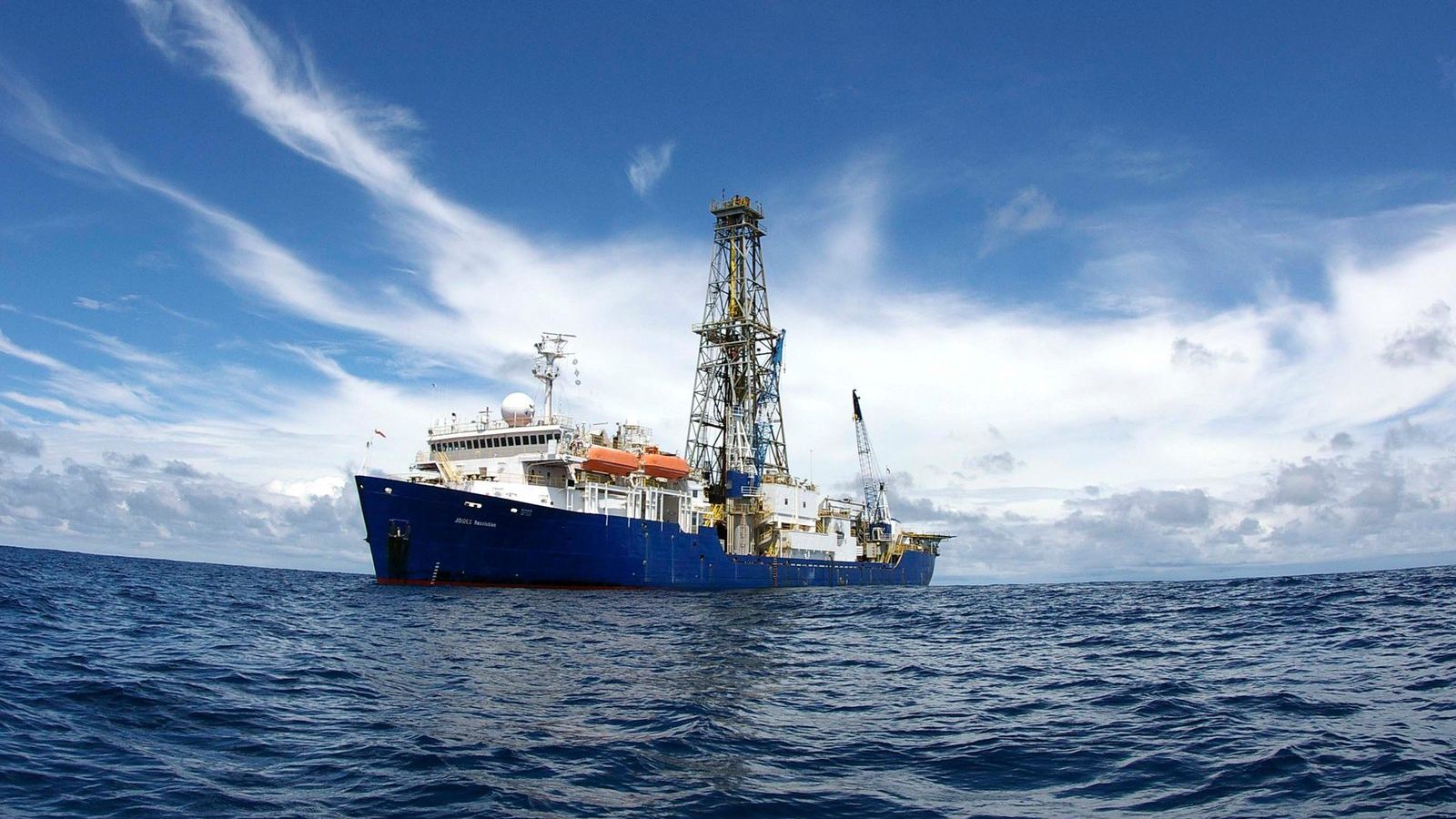
In a drill core of deep-sea sediment from the Walvis Ridge in the South Atlantic, recovered by the drilling ship in the photograph on Leg 208 of the Ocean Drilling Program in 2003, the pale carbonate ooze that makes up most of the core is interrupted, 56 million years down, by a layer of red clay 10 to 35 cm thick. The clay is what remains when the calcium carbonate of the ooze, the shells of the plankton, has been dissolved away. For a few tens of thousands of years the deep ocean was acid enough to dissolve shells on its floor, and above the clay the ooze returns slowly, over about 100,000 years. The layer marks the Palaeocene-Eocene Thermal Maximum, the PETM, which is the best-studied natural release of carbon in the geological record.
What the isotopes show
The event was first seen in 1991, in the carbon and oxygen isotopes of foraminifera in a core from the Weddell Sea off Antarctica. The ratio of carbon-13 to carbon-12 in the shells drops suddenly by 2 to 3 parts per thousand, and in soils and plants on land by 4 to 6, and then recovers over 150,000 to 200,000 years. A drop like that means that a large amount of carbon with a low proportion of carbon-13 entered the atmosphere and the ocean. The only large reservoirs of such carbon are organic: the methane locked in frozen hydrates under the sea floor, coal and other buried organic matter, and peat and soil. Volcanic carbon dioxide from the mantle has a higher carbon-13 content and cannot by itself produce the drop, though volcanism in the opening North Atlantic, which baked organic-rich sediments as magma intruded them, is now the leading candidate for the trigger. At the same time the oxygen isotopes show the ocean warming: the deep sea by about 4 to 5 °C, the surface in the tropics by about 5 °C and at high latitudes by 8 °C or more. Crocodiles and palms lived in the Arctic. Mammals, including the first horses, became smaller and spread across the northern continents by land bridges that the warmth opened.
How much carbon
The size of the release is estimated two ways, and Unit 16 of the masterclass does both calculations. The first uses the isotope excursion: the lighter the source, the less carbon is needed to shift the ocean's ratio by the observed amount. Methane from hydrates, at about −60 parts per thousand, needs about 2,000 to 3,000 billion tonnes of carbon; organic carbon from sediments, at about −25, needs 5,000 to 10,000. The second uses the dissolution. The carbonate compensation depth, the depth below which shells dissolve faster than they arrive, rose from about 4 km to less than 2 km at Walvis Ridge, and the amount of carbon dioxide needed to acidify the deep ocean that much is at least 3,000 to 4,000 billion tonnes of carbon. Both estimates point to several thousand billion tonnes, with the most-cited recent figure around 10,000. For comparison, all the fossil fuel that humans have burned since 1850 amounts to about 500 billion tonnes of carbon, and the known reserves of coal, oil, and gas hold perhaps 3,000 to 5,000 more.
How fast
The rate matters more than the total for the ocean, because the ocean neutralizes carbon dioxide on a timescale of a few thousand years by dissolving carbonate on its floor and by weathering rocks on land. A release that is slower than this is absorbed with little acidification; a faster one overwhelms it. The onset of the PETM has been timed from the layers in the cores. Richard Zeebe, Andy Ridgwell, and James Zachos showed in 2016, from the lag between the carbon and the oxygen isotope changes, that the main release took at least 4,000 years, and most estimates put it between 4,000 and 20,000 years. Dividing a release of a few thousand billion tonnes by 4,000 years gives about 1 billion tonnes of carbon a year, and the 2016 paper's own upper limit for the rate of the onset is 1.1 billion tonnes a year; dividing the lower estimates by the longer durations gives a few tenths. Present emissions from fossil fuels and cement are about 10 billion tonnes of carbon a year. The present release is therefore about ten times faster than the fastest natural carbon release of the last 66 million years. That is the result of the 2016 paper, which is at doi.org/10.1038/ngeo2681.
The worked number
How much does carbon warm the planet? The PETM released several thousand billion tonnes of carbon and the planet warmed by about 5 °C, from a starting point already warmer than today, with no ice sheets. The relation between carbon and temperature is roughly logarithmic: each doubling of carbon dioxide gives a similar warming, and a doubling corresponds to about 600 billion tonnes of carbon added to the pre-industrial atmosphere, less once the ocean has taken its share. Several thousand billion tonnes is two to three doublings; two doublings at 2 to 3 °C each gives 4 to 6 °C, which matches the record. The same arithmetic applied to the 500 billion tonnes emitted so far, after the ocean and the land have absorbed about half, gives about 1.2 °C, which also matches. The rock record and the thermometer agree on the sensitivity, and that agreement is the main reason geologists are confident about the number.
What the PETM did not do
The PETM caused a major extinction of the foraminifera that live on the deep-sea floor, about half of whose species disappeared, and little else; surface life adapted, migrated, and diversified. The warming lasted about 100,000 years before weathering and burial drew the carbon down. The difference from the present is the rate: the ocean of the PETM had thousands of years to buffer each increment, and the present ocean has decades, which is why the surface ocean today is acidifying faster than at any point in that record. Unit 13 explains how the isotopes and the dissolution are read from the cores, and the data from Walvis Ridge, published by Zachos and colleagues in 2005 at doi.org/10.1126/science.1109004, are archived with thousands of other palaeoclimate records at PANGAEA.