 Image: Hannes Grobe, Alfred Wegener Institute for Polar and Marine Research (CC BY-SA 2.5)
The air of 800,000 years ago, in a bubble
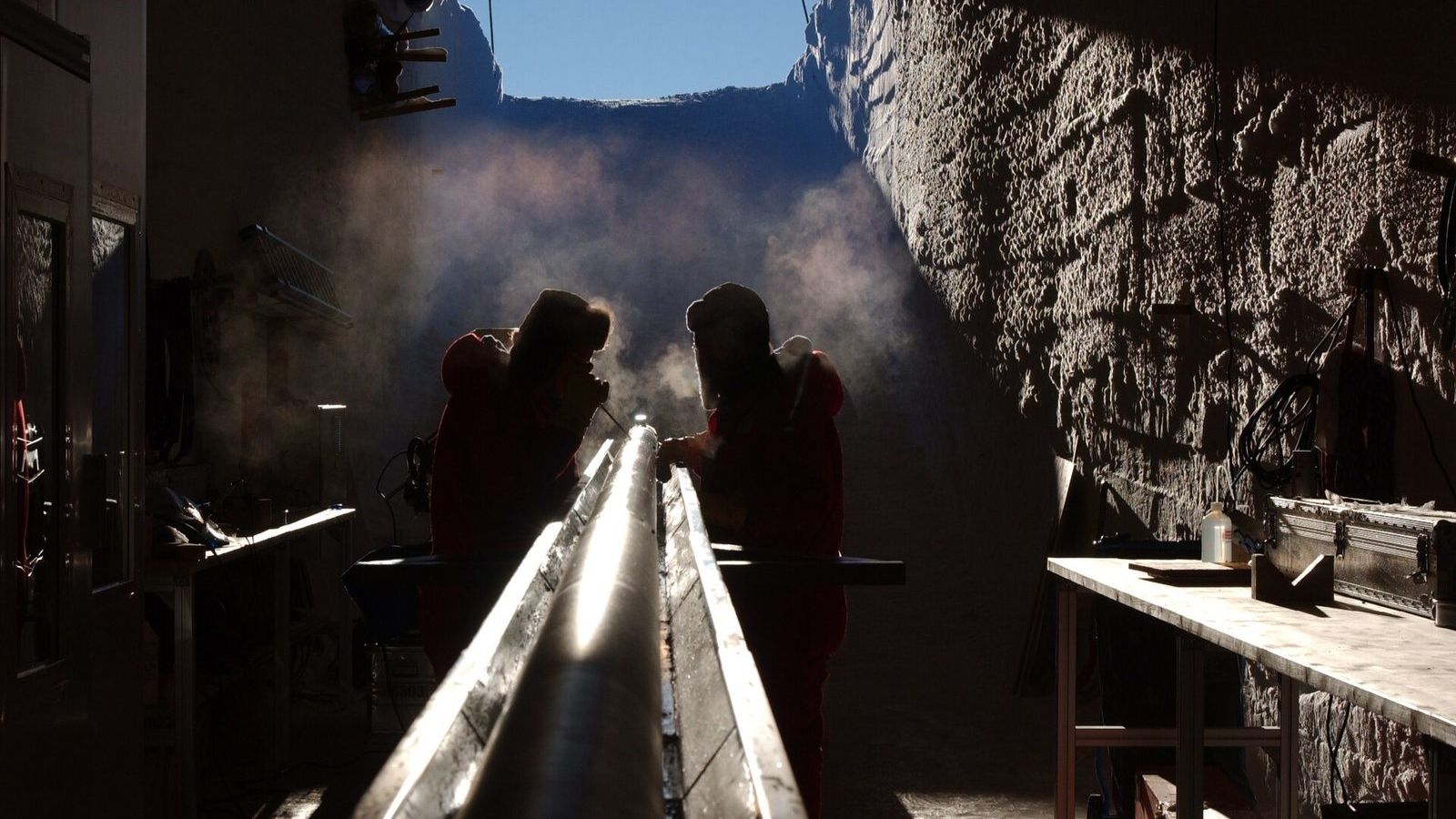
The air inside a bubble in a piece of Antarctic ice is a sample of the atmosphere from the time the bubble closed. Open the ice in a vacuum, let the gas out, and a mass spectrometer or a laser analyser gives the carbon dioxide and methane content of the air as it was when a mammoth was breathing it. The longest such record comes from a drill hole at Dome C, on the East Antarctic plateau at an altitude of 3,233 m, where the European Project for Ice Coring in Antarctica, EPICA, reached a depth of 3,270 m in December 2004 after eight seasons of drilling. The bottom of that drill core is about 800,000 years old. The picture shows the EPICA drill at the project's other site, Kohnen Station in Dronning Maud Land.
How the air gets in
Snow on the plateau does not melt. It accumulates, a few centimetres a year at Dome C, and the weight of new snow compresses the old into firn, a granular material like a hard snowball with air in the spaces between the grains. The air in the firn mixes freely with the atmosphere above through those spaces. Between about 50 and 120 m down, depending on the site, the grains are pressed together so tightly that the spaces close off into separate bubbles, and from that depth on the air is sealed. Deeper still, below about 1,000 m, the pressure forces the gas molecules into the ice lattice itself, forming clathrates, and the bubbles disappear; they re-form when the ice is brought to the surface and left to relax for a year, which is why deep ice is stored before it is measured.
The sealing takes time, and that is the first subtlety of the method. At Dome C, where snow falls slowly, the firn is about 100 m thick and takes about 2,000 to 3,000 years to turn into ice during a warm period and up to 5,000 years during a glacial, when snowfall is lower. So the air in a bubble is younger than the ice around it by that amount, which glaciologists call the delta age, and it has to be modelled for each depth before the gas and the ice can be compared. Unit 13 of the masterclass explains the firn column and the delta age with the numbers.
How the ice is dated
The upper part of a core can be dated by counting annual layers, where snowfall is high enough for summer and winter to leave distinct bands, but at Dome C the layers are too thin. The age scale there comes from several methods tied together: the known dates of volcanic ash layers and sulfate spikes that also appear in other cores, the thinning of the layers calculated from the flow of the ice sheet, the changes in the oxygen isotopes of the trapped air, which track the Earth's orbital cycles with known periods, and matching with the dated deep-sea record. The result, called AICC2012 and revised since, has an uncertainty of a few hundred years near the top and a few thousand years at the bottom. Layers thin with depth: the top 1,000 m of the Dome C core covers about 60,000 years, and the lowest few hundred metres cover more than half of the 800,000.
What the bubbles say
The carbon dioxide record from Dome C, published by Dieter Lüthi and colleagues in 2008 and extending the earlier record from the Vostok core, shows the same pattern repeating eight times over 800,000 years. During the ice ages, carbon dioxide fell to between 180 and 200 parts per million by volume. During the warm interglacials, including the one we live in, it rose to between 260 and 300. The rises are fast and the falls slow, like a saw tooth, and the temperature of Antarctica, read from the hydrogen isotopes of the ice itself, follows the same curve. The glacial minimum of about 180 ppm is the lowest the atmosphere has reached in the whole record. The highest, about 300 ppm, was in the interglacial of 320,000 years ago. The pre-industrial value, read from the youngest bubbles and from cores elsewhere, is 280 ppm, and the value in the air above Dome C today is above 420.
Methane shows the same cycle, between about 350 and 700 parts per billion, and because methane is mixed through the atmosphere in a year, the methane in Antarctic and Greenland cores can be used to line up the two records to within a few decades. Nitrous oxide follows too. The air also carries the isotopic composition of oxygen, which records the size of the ice sheets, and the ice carries dust from Patagonia, which was ten to twenty times more abundant in glacial periods, when the southern continents were dry and windy.
The worked number
How much carbon is a hundred parts per million? The atmosphere has a mass of about 5.1 × 10¹⁸ kg, and carbon dioxide has a molecular mass of 44 against 29 for air, so one part per million by volume of carbon dioxide is 5.1 × 1018 × 10−6 × 44/29 = 7.8 × 10¹² kg of carbon dioxide, which contains 12/44 of its mass as carbon, 2.1 × 10¹² kg, or 2.1 billion tonnes of carbon. The glacial to interglacial rise of 100 ppm is therefore about 210 billion tonnes of carbon moved from the ocean into the air, and it took about 10,000 years each time. Human emissions are about 10 billion tonnes of carbon a year, and the rise from 280 to 420 ppm, 140 ppm, has taken about 170 years. The rate of the present rise is about a hundred times the rate of the fastest natural rise in the ice-core record. Unit 16 puts that number against the rock record further back.
Older ice
The Dome C record ends at 800,000 years because the ice below is too thin and too disturbed to read. In January 2025 the Beyond EPICA project, drilling at Little Dome C a few kilometres away, reached bedrock at 2,800 m, and the bottom of that core is expected to extend the record of air to at least 1.2 million years, across the transition when the ice ages changed from a 41,000-year to a 100,000-year rhythm, which Unit 14 discusses. The data from Dome C and every other published ice core can be downloaded from the NOAA Paleoclimatology archive, the tool of the week for Unit 13, and plotted in a spreadsheet in a few minutes; the 2008 paper is at doi.org/10.1038/nature06949.