Climate Archives in Rock and Ice
The instrumental record of climate is about 170 years long and the questions of geology span millions, so past climate is read from proxies: properties of ice, shells, cave calcite, soils, leaves, and rocks that depend on climate and are calibrated against the present. This unit shows how bubbles in Antarctic ice hold 800,000 years of air, how the oxygen isotopes of a foraminiferal shell record both the temperature of the sea and the volume of ice on land, how speleothems are dated with uranium and leaves read for carbon dioxide, how a rock's magnetization says where it formed, and where every one of these proxies fails.
Thermometers have been read in a few European cities since the late seventeenth century, but a network dense enough to give the temperature of the whole planet exists only since about 1850, so the instrumental record of climate is about 170 years long. The questions this masterclass asks reach back a thousand times further, to the end of the last ice age, to the glacial cycles, and to the warm worlds of the Cretaceous and the Eocene. For all of them the evidence is a material that formed at the time and kept an imprint of the climate around it in its chemistry or its structure. This unit explains how such imprints are read, how the readings are calibrated against the present, and where each of them fails. Units 14 to 16 use the tools assembled here.
1 Archives and proxies
A climate archive is any natural material that was laid down in order, layer upon layer, so that depth in it is a measure of time. A proxy is a measurable property of an archive that depends on a climate variable, such as the width of a tree ring, which depends on summer temperature or rainfall, or the ratio of two oxygen isotopes in a shell, which depends on the temperature of the water the shell grew in. It stands in for the thermometer that nobody held at the time.
A proxy becomes a measurement only through calibration. The property is measured in modern material whose climate is known, such as shells collected alive at known water temperatures, and the relation found there, called the transfer function, is applied to the fossil material. Two assumptions are built into every such step. The first is uniformitarian in the sense of Unit 1, that the organism or the mineral responded to climate in the past as it does today. The second is that the fossil value lies inside the range over which the calibration was made, because a relation measured between 290 and 430 ppm (parts per million) of carbon dioxide says nothing reliable about 1,500 ppm. Section 4 shows a case where this second assumption fails.
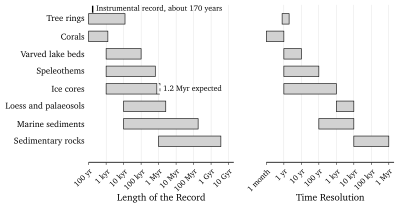
Figure 1 places the archives on the two scales of the second principle. Tree rings give one value per year, and the oak and pine chronology assembled at Hohenheim in southern Germany reaches back 12,460 years without a gap; it is this chronology against which radiocarbon dates are calibrated (Unit 9). Ages in this unit, and on the axes of its figures, are given in years before present, and “present” is by convention the year 1950, the reference year of radiocarbon dating. A coral colony records the surface water month by month in its chemistry, but lives a few centuries. Lakes whose sediment is laid down in annual couplets, one pale and one dark layer a year, called varves, keep the annual resolution of a tree ring for far longer; the varves of Lake Suigetsu in Japan have been counted through 52,800 years. Cave deposits reach back about 640,000 years, ice cores 800,000, and the wind-blown dust of the Chinese Loess Plateau about 2.6 million years. Sediments on the ocean floor are the longest continuous archive, back to about 180 million years, the age of the oldest sea floor still in place (Unit 6); everything older survives only as rock, and a bed of rock resolves thousands of years at best, not single years.