 Image: Bahudhara (CC BY-SA 3.0)
When the Earth froze over
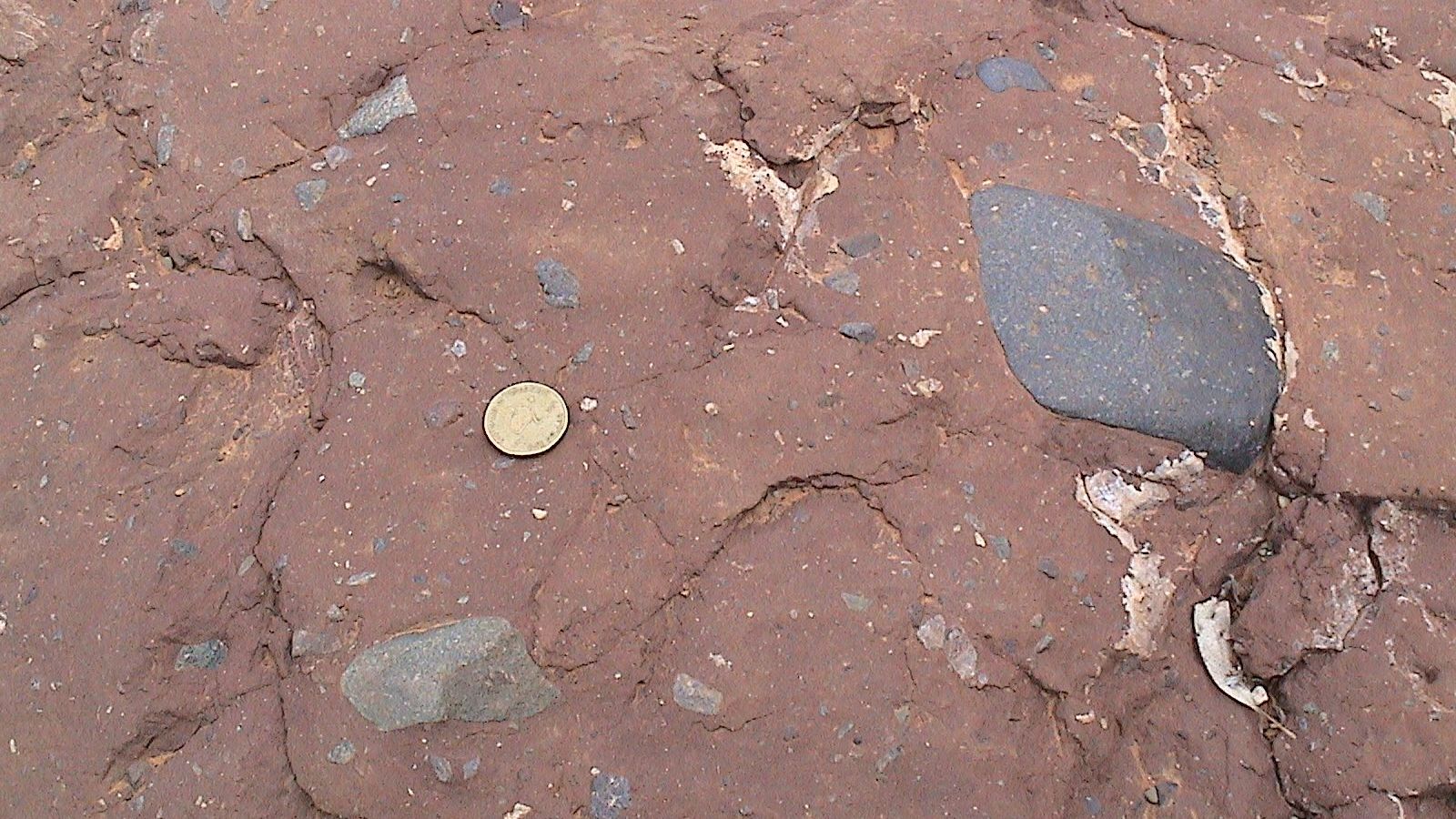
The rock in the photograph is a diamictite: pebbles and boulders of many kinds, some scratched, set in a fine muddy matrix, with no sorting at all. It is the deposit a glacier leaves, the equivalent of the till under the fields of northern Europe and North America, except that this one is about 635 million years old and lies in the Flinders Ranges of South Australia. When it was deposited, South Australia was within about 10 degrees of the equator, at sea level. There were glaciers at the equator, at sea level, and there is only one way to get them: the whole planet was frozen.
Two ice ages
The Cryogenian period, from 720 to 635 million years ago, takes its name from this. Its rocks hold two great glacial deposits, found on every continent. The older, the Sturtian, named from Sturt Gorge in South Australia, began at about 717 million years ago and lasted about 57 million years. The younger, the Marinoan, named from Marino near Adelaide, ended at 635 million years ago and lasted perhaps 5 to 15 million years. The ages come from uranium-lead dates on zircons in volcanic ash within and around the deposits, mostly measured since 2010, and the start of the Sturtian is now one of the better-dated moments of the Precambrian. The Elatina Formation in the picture is Marinoan.
How you know where a rock was
The claim that the glaciers reached the equator rests on palaeomagnetism. When a sediment is deposited, its magnetic grains line up with the Earth's field and keep that direction once the rock is hard. The field lines are horizontal at the equator and vertical at the poles, so the inclination of the frozen-in magnetism gives the latitude at which the rock formed. The Elatina Formation has an inclination that puts it within about 10 degrees of the equator, and the result has been checked by tests that show the magnetization is original rather than acquired later. Similar results come from Marinoan deposits in Namibia and from Sturtian deposits elsewhere. The Earth's field may have been unusual at the time, which is one of the arguments made against the interpretation, and the masterclass presents it as a strong case rather than a closed one.
The runaway
The physics of the snowball was worked out in the 1960s by Mikhail Budyko in Leningrad, who showed in a simple climate model that if ice ever spread to within about 30 degrees of the equator, it would not stop. Ice reflects most of the sunlight that falls on it, so an ice-covered sea absorbs less heat than open water, cools further, and freezes further, which is a feedback that runs away. Budyko thought that such a planet could never thaw and that therefore it had never happened. The geological name was given by Joseph Kirschvink of the California Institute of Technology in 1992, who also proposed the way out, and the hypothesis was made famous by Paul Hoffman and colleagues at Harvard in a paper of 1998 on the rocks of Namibia.
The way out, and the cap
The way out is volcanoes. On a frozen Earth, rain and the weathering of rocks stop, and weathering is the process that removes carbon dioxide from the air over geological time. Volcanoes keep emitting it regardless, so carbon dioxide builds up in the atmosphere over millions of years until the greenhouse effect overwhelms the reflecting ice, which at the tropics may need something like a hundred times the present concentration. Then the thaw is fast, perhaps a few thousand years, and the planet goes from the coldest state it has known to one of the hottest.
The evidence for that is the cap carbonate. Everywhere in the world, the Marinoan glacial deposits are overlain, with a knife-sharp contact, by a layer of limestone or dolostone a few metres to a few tens of metres thick, pale, finely laminated, often with strange crystal fans and structures that formed as the rock was deposited at speed. Limestone is a warm-water rock and a glacial deposit is not, and the two are in contact with nothing between. The chemistry of the thaw explains it: a hot, acidic, carbon-dioxide-rich atmosphere weathers the exposed continents furiously, the rivers carry calcium and bicarbonate to the sea, and carbonate is precipitated on a vast scale as the carbon dioxide is drawn down. The cap carbonates have very light carbon isotopes, which is part of the same story and part of the ongoing argument about it. Unit 15 of the masterclass takes the reader through a Namibian section, from the diamictite into the cap and the greenhouse above it.
Slushball or snowball
How complete was the freeze? The hard snowball, with the ocean frozen over everywhere to a kilometre's thickness, has trouble explaining how life, including the eukaryotic algae that are found before and after the glaciations, survived for 57 million years, and how the glaciers that deposited the diamictites kept moving, since a frozen ocean means no evaporation and no snow. Softer versions keep a band of open water at the equator, or thin ice that light can pass through, or glaciers fed by the sublimation of sea ice. The deposits themselves show that glaciers flowed and that there was open water at times, with ice-rafted dropstones falling into marine sediment. The debate is about how much open water and for how long, and the Marinoan, shorter and ending more abruptly, may have been harder than the Sturtian.
The worked number
What does a frozen Earth reflect? The fraction of sunlight a surface reflects is its albedo. Open ocean has an albedo of about 0.06, forest and soil 0.1 to 0.2, fresh snow up to 0.9, and sea ice about 0.5 to 0.7. The Earth as a whole reflects about 0.30 today. A planet covered by ice with an average albedo of 0.6 absorbs 40 percent of the sunlight instead of 70 percent, and since the absorbed sunlight is what sets the temperature, the equilibrium temperature falls from the present 15 °C average to about −50 °C, which is what the models give for the snowball and which is why the state is stable once reached. The equatorial ice then needs a greenhouse of about 0.1 bar of carbon dioxide, 250 times the present, to melt. Budyko's arithmetic from 1969 is still the core of the argument.
The 1998 paper by Hoffman and colleagues is at doi.org/10.1126/science.281.5381.1342, and a review by the same group in 2017, with the dates, is at doi.org/10.1126/sciadv.1600983. The data behind many of the Cryogenian sections are archived at PANGAEA, the tool of the week for Unit 15.