 Image: Daderot (CC0)
How we know what is at the centre of the Earth
The deepest hole ever drilled, the Kola Superdeep Borehole in north-west Russia, reached 12,262 m in 1989 and stopped because the rock at 180 °C was too soft to drill. The centre of the Earth is 6,371 km below the surface, so the hole went 0.2 percent of the way. Yet geologists can say with confidence that the centre is a ball of solid iron and nickel about 2,440 km across, at a temperature of about 5,000 to 6,000 °C, surrounded by a shell of liquid iron 2,260 km thick, and that the whole core began 2,891 km down. The knowledge comes from three sources: the weight of the planet, the paths of earthquake waves, and lumps of metal that fall from the sky.
The planet is too heavy to be rock
The first clue was known by 1798, when Henry Cavendish weighed the Earth with a torsion balance in his laboratory in London and found a mean density of 5.45 times that of water, close to the modern 5.51. Rocks at the surface have densities of about 2.7 to 3.0. Even allowing for compression at depth, the outer part of the Earth cannot bring the average up to 5.5, so something much denser must sit in the middle. Iron, with a density of about 7.9 at the surface and 12 to 13 at the pressures of the core, fits, and it is the commonest heavy element in the universe. The Earth's magnetic field, which needs a moving electrical conductor, pointed the same way, though the mechanism was not understood until the twentieth century.
The shadow
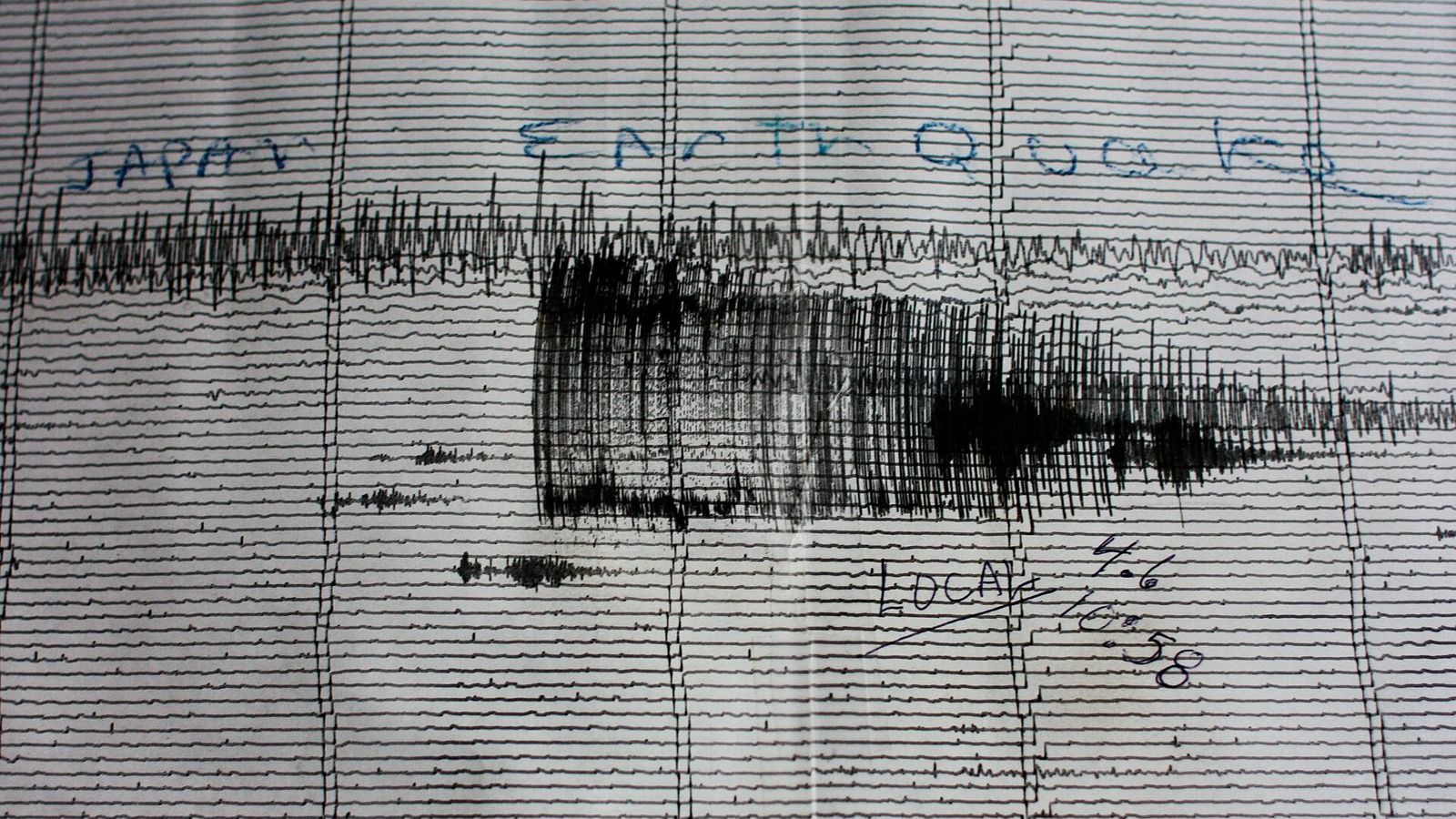
The seismograph, developed in the 1880s and 1890s, let earthquakes be recorded all over the world, and by 1900 it was clear that an earthquake sent out two kinds of waves through the body of the Earth: P waves, which are compressions, travel faster, and pass through anything; and S waves, which are shears, travel more slowly, and cannot pass through a liquid, because a liquid has no resistance to shearing. In 1906 Richard Dixon Oldham (1858 to 1936), of the Geological Survey of India, showed that P waves arriving on the far side of the Earth from a large earthquake came later than they should have if the planet were uniform rock, and argued that they had been slowed by passing through a central core of different material. In 1914 Beno Gutenberg (1889 to 1960) in Göttingen used the sharpness of the effect to fix the depth of the top of the core at 2,900 km, within 10 km of the modern value.
The core casts a shadow. Stations within about 104 degrees of arc from an earthquake receive direct P waves. Stations beyond about 140 degrees receive P waves that have gone through the core, bent sharply on the way in and out because they slow down in it. Between 104 and 140 degrees there is a band around the planet where no direct P waves arrive at all, because the bending carries them past. The S waves have a bigger shadow: none arrives anywhere beyond 104 degrees, which Harold Jeffreys (1891 to 1989) in Cambridge took in 1926 as proof that the core is liquid. Unit 10 of the masterclass draws the ray paths and explains the angles from Snell's law.
Lehmann's waves
Inge Lehmann (1888 to 1993) ran the seismological service of Denmark and spent years cataloguing the arrival times of waves from distant earthquakes on the Danish and Greenland stations. In the records of a large earthquake near New Zealand in 1929, she noticed weak P waves arriving in the shadow zone, where the theory said there should be none. They were too strong to be scattering. In a paper of 1936, with the shortest title in the history of the subject, "P'", she proposed that the core has an inner part in which the waves travel faster, and that these waves had been reflected off the boundary of this inner core into the shadow. Gutenberg and Jeffreys both accepted the idea within two years. The inner core's radius is now put at 1,221 km. It is solid, not because it is cooler than the liquid around it, since it is the hottest part of the planet, but because the pressure there, about 330 gigapascals at its surface and 360 at the centre, which is 3.6 million atmospheres, raises the freezing point of iron above the temperature. It is growing by about a millimetre a year as the Earth cools, and the latent heat and the light elements released as it freezes drive the convection in the liquid outer core that generates the magnetic field.
The recipe from the sky
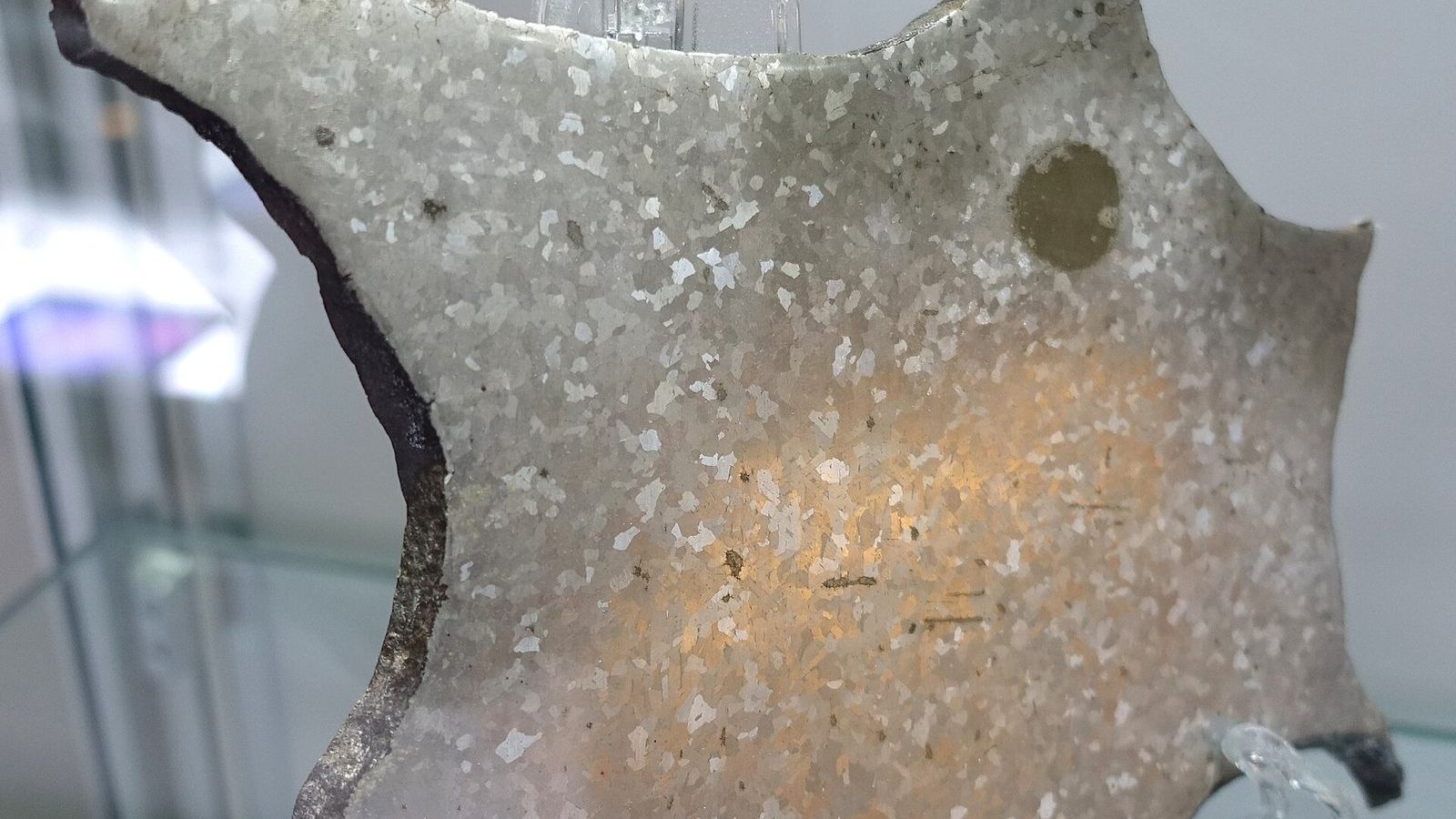
Seismology gives the sizes, the densities, and the state of the layers. It does not say what they are made of. The composition comes from meteorites, and the argument runs like this. Meteorites are pieces of asteroids, left over from the formation of the solar system; the commonest kind, the chondrites, have never been melted and have the composition of the original material from which the planets were built. If the whole Earth has chondritic composition, then its iron content is about 32 percent by mass, and almost none of that iron is in the crust and mantle, whose rocks are only about 6 to 8 percent iron. The missing iron must be in the core, and the amount needed matches the core's mass, about a third of the planet. The iron meteorites, such as the Willamette meteorite in the picture, are the cores of small asteroids that melted, separated into metal and rock just as the Earth did, and were later broken up. They are iron with 5 to 10 percent nickel, and their crystals, which grew over millions of years of slow cooling, show the pattern seen when a slice is etched with acid. The core of the Earth is probably much the same, with a few percent of lighter elements, sulfur, silicon, oxygen, or hydrogen, which the seismic density needs and which are still argued over.
The worked number
How fast does a P wave cross the planet? From an earthquake, a P wave reaches the opposite side of the Earth, 12,742 km away through the centre, in about 20 minutes, a mean speed of about 10.6 km per second, while a wave that passes through the core enters it at 13.7 km per second in the lowest mantle, drops to 8 km per second in the liquid outer core, and rises again to about 11 km per second in the inner core. Compare that with the 5 to 6 km per second of P waves in the crust, or the 340 m per second of sound in air. Seismologists know these speeds to a fraction of a percent, and the whole picture of the interior is built from millions of arrival times recorded over a century.
The live map of the US Geological Survey at earthquake.usgs.gov shows every earthquake of the last month; each of them is also a probe of the deep Earth, and the masterclass's Unit 10 takes the reader from the seismogram to the layers in the order the discoveries were made.