 Image: jxandreani (CC BY 2.0)
The worst day in the history of life
Of the five great mass extinctions in the fossil record, the one at the end of the Permian period, 251.9 million years ago, is the largest by a wide margin. Estimates of the proportion of marine species lost run from about 80 to 96 percent, depending on how the counting is done; the lower figure is the more careful one, and even it means that four out of every five species in the sea disappeared. The trilobites, which had lived for 270 million years, ended here. So did the rugose and tabulate corals, which had built the reefs of the Paleozoic era, most of the brachiopods, the sea scorpions, and the blastoids. On land, the forests of Glossopteris in the south vanished and insects suffered the only mass extinction in their history. The recovery took about 10 million years, longer than after any other extinction.
The volcanoes
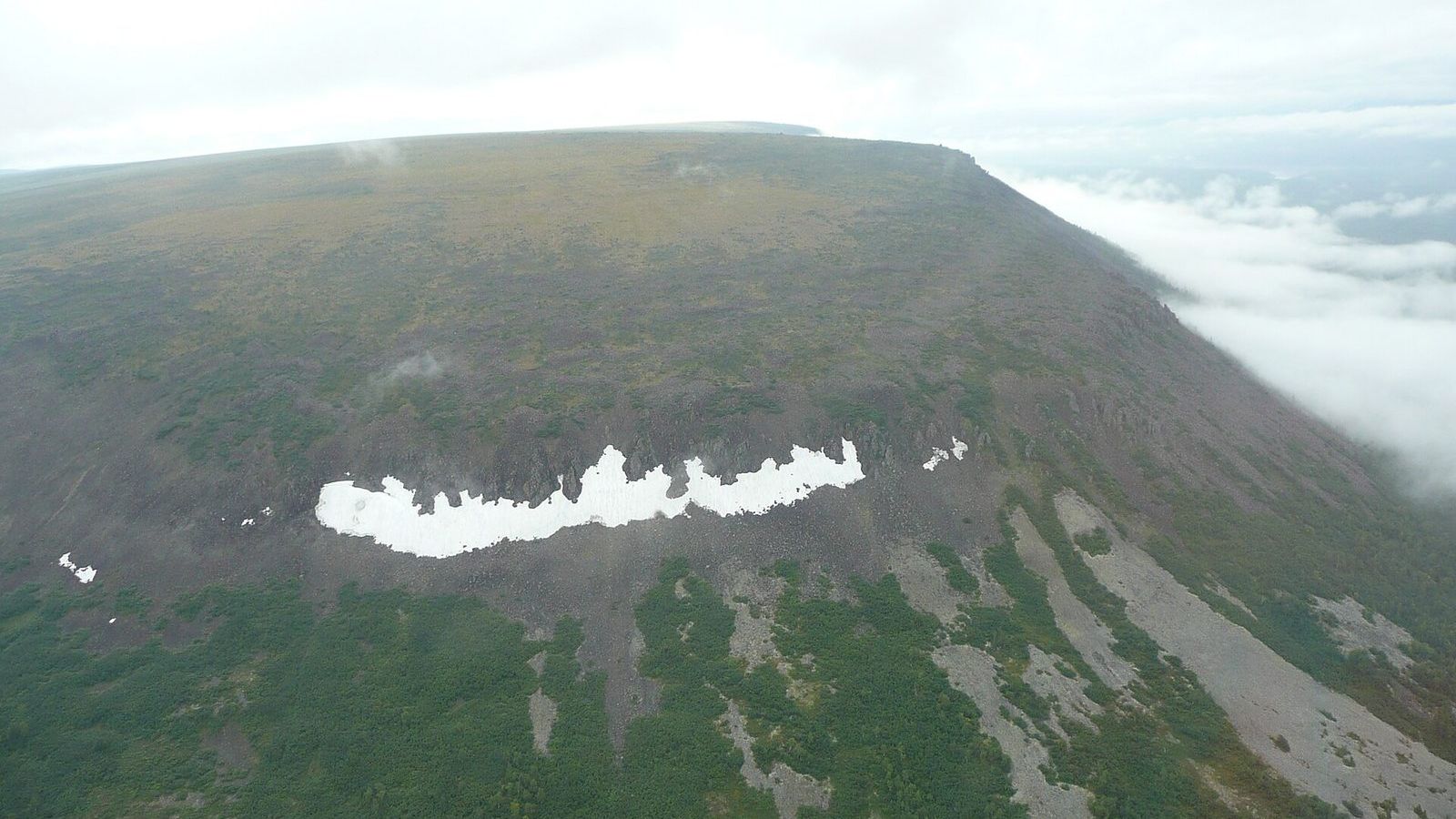
The Siberian Traps, in the picture above, cover about 2 million km² of northern Siberia with basalt lava flows, ash, and the intrusions that fed them; the original province was larger, perhaps 7 million km² with a volume of the order of 3 to 4 million km³ of magma, which makes it the largest volcanic province on the continents. The lava erupted through a basin of coal, limestone, and salt deposits, and this matters, because magma that cooks coal and limestone releases carbon dioxide and methane, and magma that cooks salt releases chlorine and halogens that destroy ozone. The province was erupted in a geologically short time. Seth Burgess and Samuel Bowring dated zircons from its lavas and intrusions by uranium-lead in 2015 and found that about two thirds of the volume erupted in the 300,000 years before the extinction and the rest in the 500,000 years after.
The clock at Meishan
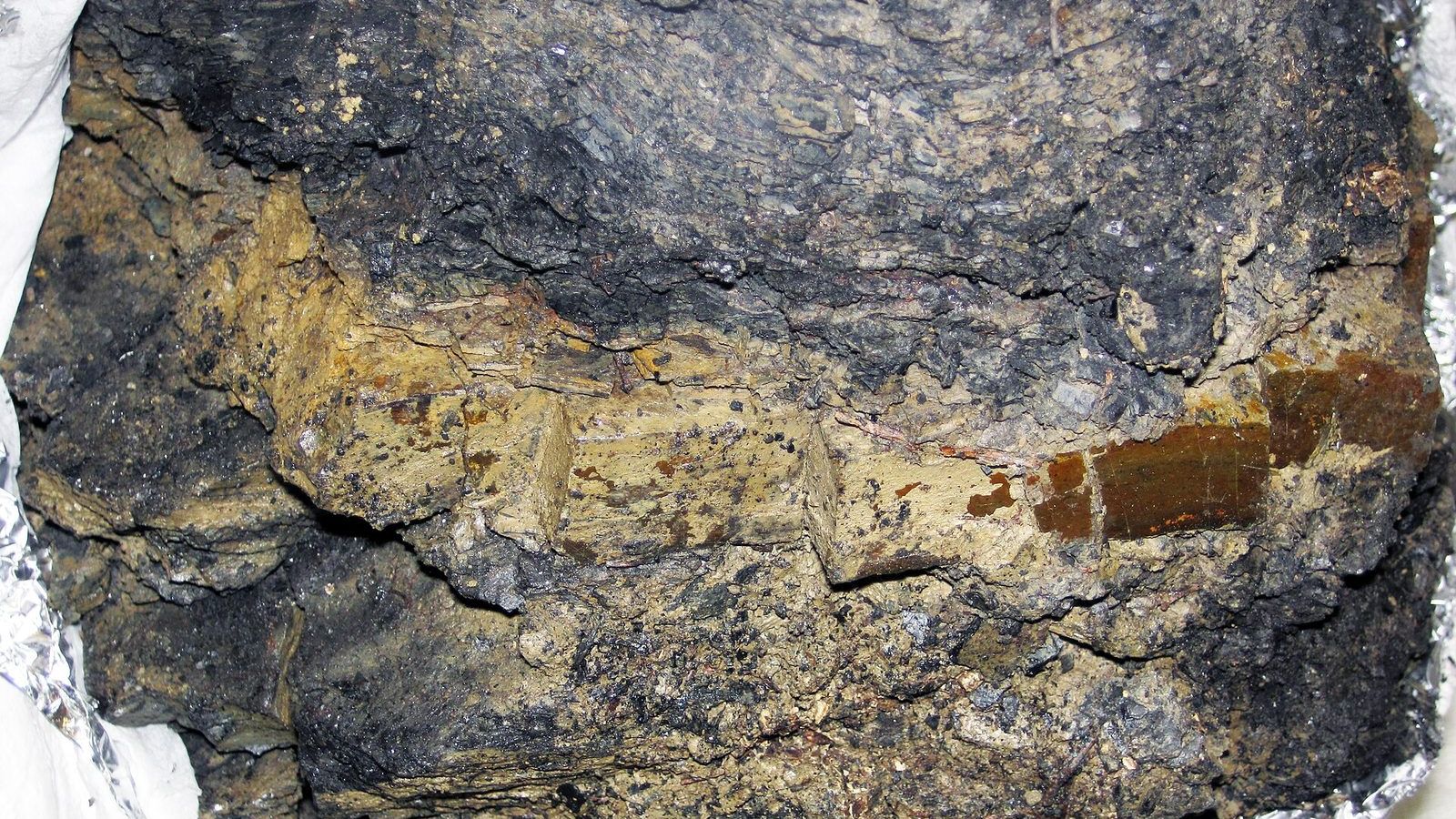
The boundary between the Permian and Triassic periods is defined at a quarry at Meishan in Zhejiang province, China, in a succession of limestones with layers of volcanic ash between them. The ash layers contain zircons, and the limestones contain the fossils that show the extinction happening: the conodonts, ammonoids, brachiopods, and foraminifera of the late Permian thinning out and disappearing through a few metres of rock. In 2014 Burgess, Bowring, and Shu-zhong Shen dated the ash beds by uranium-lead on single zircons, with the chemical abrasion method that removes the parts of a crystal that have lost lead, and obtained ages with uncertainties of about 30,000 years. The ash just below the main extinction horizon gave 251.941 ± 0.037 million years, and the ash just above it 251.880 ± 0.031 million years. The extinction, in the rocks between, took at most about 60,000 years and probably less. On the scale of the Phanerozoic, that is a day.
What the carbon and the oxygen say
The rocks across the boundary record the chemistry of the ocean. The ratio of carbon-13 to carbon-12 in the limestone drops by several parts per thousand, which means a large mass of carbon with a light isotopic signature entered the ocean and the air: the carbon dioxide and methane of the volcanoes and the baked coal. Oxygen isotopes in the phosphate of conodont teeth, which record the temperature of the sea water the animals lived in, show the tropical ocean warming by about 8 °C across the boundary and reaching surface temperatures of about 40 °C in the earliest Triassic, a figure that Yadong Sun and colleagues published in 2012 under the title "Lethally hot temperatures during the Early Triassic greenhouse". Sea water that warm holds little oxygen, and the sediments of the earliest Triassic are black, laminated, and full of pyrite, which is what anoxic sea floor leaves. Boron isotopes in the same rocks point to acidification of the sea as the carbon dioxide dissolved in it, which would explain why the animals with heavy calcium carbonate skeletons, the corals and the brachiopods, were hit hardest.
Each of these lines of evidence has its own uncertainties, and Unit 12 of the masterclass takes them one by one. Together they describe a planet whose air was loaded with carbon dioxide faster than the oceans and the weathering of rocks could remove it, whose oceans warmed, acidified, and lost their oxygen, and whose ozone layer may have been thinned by halogens, all within a few tens of thousands of years, with the Siberian Traps as the only plausible source of that much carbon that fast.
The worked number
How much carbon? The drop in the carbon isotope ratio of about 5 parts per thousand, if it came from carbon with the isotopic composition of coal or volcanic gas, needs a release of the order of 10,000 to 40,000 billion tonnes of carbon; different assumptions about the source give different totals, which is why the range is wide. Spread over 60,000 years, the lower figure is about 0.2 billion tonnes of carbon a year. Human burning of coal, oil, and gas releases about 10 billion tonnes of carbon a year, fifty times faster. The total so far, since 1850, is about 500 billion tonnes, a twentieth of the lower Permian figure. The comparison is one the masterclass makes carefully in Unit 16, because the rate and the total do different things to the ocean, and because the Permian release went on for far longer than any human timescale.
What came after
The Triassic that followed began with an empty, hot ocean in which a few survivors, the bivalve Claraia and a handful of ammonoid and conodont lineages, spread across the world. Reefs did not return for about 10 million years. On land the dominant large animal for a while was a pig-sized relative of mammals, Lystrosaurus, which makes up most of the vertebrate fossils in some earliest Triassic rocks. The archosaurs that filled the empty niches afterwards included the first dinosaurs, so the extinction that ended the Paleozoic era set the table for the Mesozoic. The 2014 dates are at doi.org/10.1073/pnas.1317692111 and the Siberian Traps dates of 2015 at doi.org/10.1126/sciadv.1500470. Readers who want to see the extinction in the fossil record can set the Paleobiology Database Navigator to the Permian, then to the Triassic, and watch the map of fossil collections empty.