The History of the Earth
The closing unit of the Foundation masterclass tells the whole story the earlier units gave the tools for: the birth of the planet and its iron core, the Hadean ocean recorded in zircon grains, the oxygen-free Archean and its stromatolites, the Great Oxidation Event, the supercontinents, the Cryogenian ice ages, and the Phanerozoic era by era. It ends with the three patterns behind the story: the record thins with age, the planet works as a system, and most of its history is Precambrian.
The seven units before this one taught the tools: how to put beds in order, what minerals and rocks are, how they form and change, how the plates move, and how mountains are built. This unit uses all of them at once to read the longest story there is, the 4,540 million years of the Earth itself, from a ball of molten rock to a planet with oxygen in its air, ice at its poles, and people on its surface. The story is told in the order in which it happened, and it ends with the question of why the rocks tell so much less of it the further back one goes.
1 How the history is read
Nobody watched the Earth form, and no single outcrop shows more than a sliver of its history. What geologists have instead is the method of Unit 1 applied a hundred thousand times over: beds put in order by superposition and cross-cutting relationships, outcrops correlated by their fossils (Unit 4), and the local columns joined into the geological time scale. That scale, whose divisions were named in Unit 1, is the result of two centuries of work. The order of its divisions was fixed in the nineteenth century from the fossils of Europe, long before anyone could say how many years any of its divisions lasted, and the numbers were attached later, one by one, from the decay of radioactive elements in minerals. How those numbers are measured lies beyond the Foundation units; here they are used as the chart of the International Commission on Stratigraphy gives them, in the notation of Unit 1, where “Ma” means million years ago and “Ga” billion years ago.
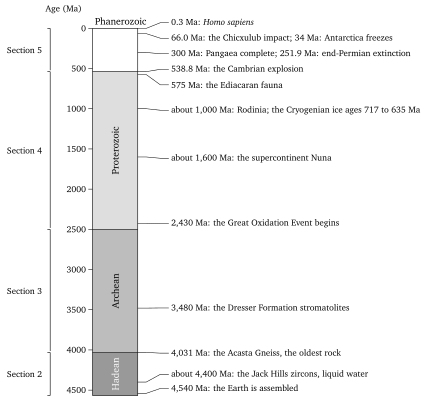
Figure 1 draws the whole history as one column, to scale, with the oldest rocks at the bottom as in every stratigraphic column, and marks the events this unit describes. Two things stand out before any of them is read. The Phanerozoic eon, the part of the record with abundant fossils, is only the top eighth of the column; the other seven eighths, the Precambrian, hold the birth of the planet, the first life, and the oxygen in the air. The column is drawn to scale in time, but the amount of rock that survives from each part of it is not in proportion: the beds that record the Archean would fill a bookshelf, while those of the Cenozoic would fill a library.