 Image: dave souza (CC BY-SA 4.0)
Siccar Point, where Hutton saw deep time
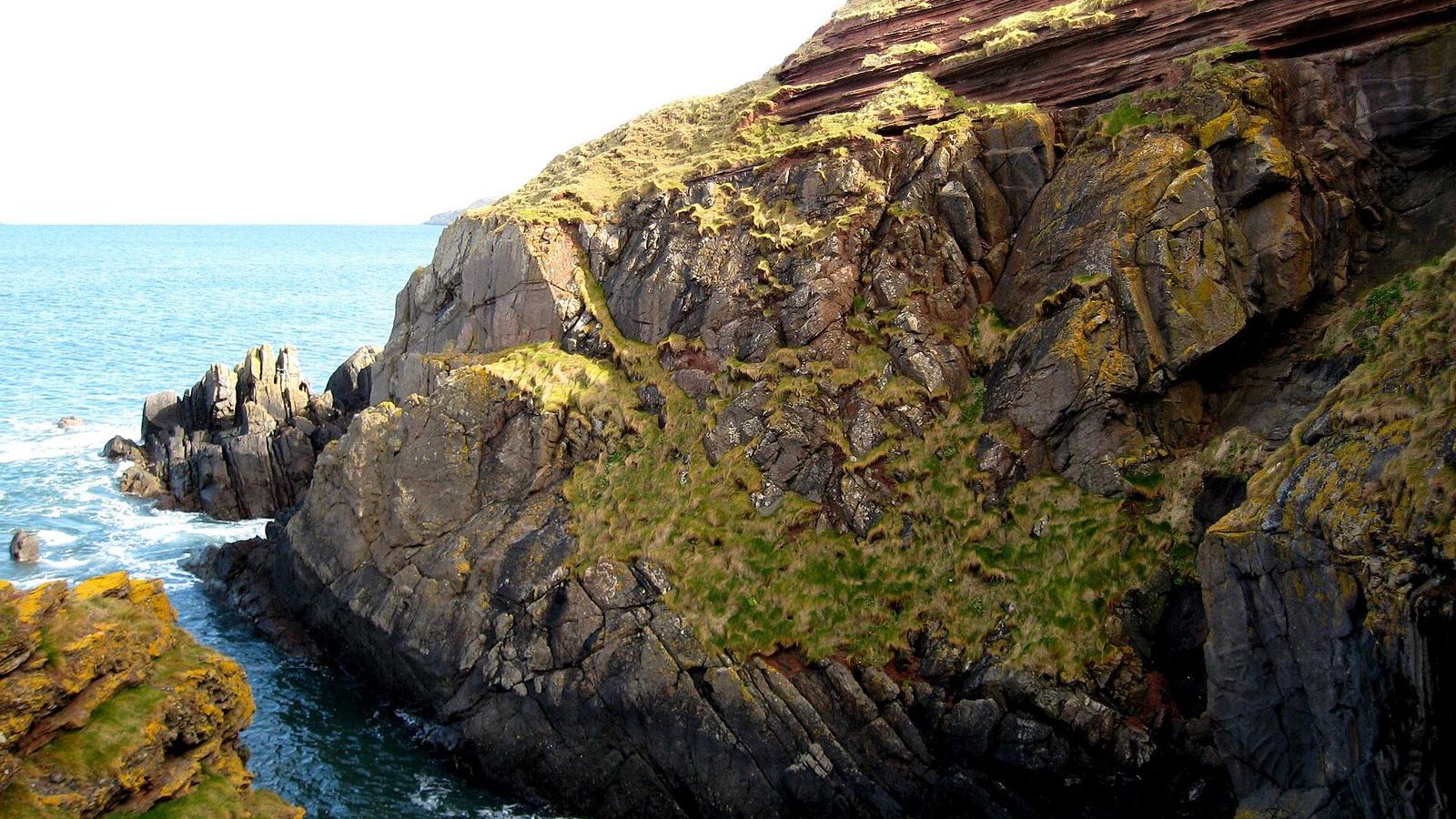
Siccar Point is a low headland of rock on the coast of Berwickshire, in south-east Scotland, about 60 km east of Edinburgh. It is not much to look at from the road: a grassy slope, a cliff, and the North Sea. Walk down the slope and you find two sets of rock beds meeting at an angle. The lower set stands nearly vertical, grey and hard. The upper set lies almost flat on top of the broken ends of the lower one, and is red and crumbly. In June 1788 three men landed here from a boat, and one of them wrote afterwards that "the mind seemed to grow giddy by looking so far into the abyss of time". The outcrop has been a place of pilgrimage for geologists ever since.
Who was in the boat
James Hutton (1726 to 1797) was a farmer, a doctor by training, a chemist, and a member of the circle of the Scottish Enlightenment in Edinburgh. He had spent decades looking at rocks and had come to a view that was strange for his time: that the Earth's surface is worn away by rain and rivers, that the debris is laid down in the sea as new beds, that these beds are later consolidated, heated, lifted, and tilted to form new land, and that this cycle has run for an immense time with, in his words, "no vestige of a beginning, no prospect of an end". He had read a version of this theory to the Royal Society of Edinburgh in 1785. What he needed was a place where the cycle could be seen in one view.
With him were John Playfair (1748 to 1819), a mathematician who would later write the clearest account of Hutton's ideas, and Sir James Hall (1761 to 1832), a young landowner and experimenter who would go on to melt rocks in furnaces to test them. Hall owned the land along this coast. The three took a boat from Dunglass and worked eastward along the cliffs, because the best exposures were at the water's edge and could not be reached on foot.
What they saw
The lower beds at Siccar Point are greywacke, a hard, poorly sorted sandstone deposited by underwater avalanches on a deep sea floor. They were laid down in the Silurian period, about 435 million years ago, and are the sediments of an ocean, the Iapetus, that then lay between Scotland and England. When that ocean closed and its two sides collided, the beds were folded, tilted to the vertical, and uplifted into mountains. The mountains were worn down to a plain. On the plain, much later, rivers and floods laid down the red sandstones and breccias of the Old Red Sandstone, in the Devonian period, about 370 million years ago, in a hot dry climate on a continent. Then the whole stack was buried, tilted gently, and finally exposed by erosion at the coast.
Hutton did not know any of the ages. What he could see was the order of events, and the order was enough. First the grey beds had to be deposited, flat, in water. Then they had to be hardened and turned on end, which needed force and time. Then they had to be cut off by erosion, which needed a great deal more time. Then the red beds had to be deposited on top. Then the lot had to be lifted again to where he was standing. A single cycle of his theory was drawn on the rock. The surface where the two sets meet is an angular unconformity, a term that came later; it records a gap in the record, and the gap at Siccar Point is about 65 million years.
Why this mattered in 1788
The usual view in the eighteenth century, held by many serious scholars, was that the Earth was a few thousand years old and that its rocks had been laid down in one or a few great floods. Hutton's cycle demanded time of a different order. He could not say how much, and he did not try to; his argument was that processes visible today, acting at the rates seen today, could account for everything in the rocks if they had long enough. This is the principle that Charles Lyell would later call uniformitarianism and that every geologist now uses without thinking about it. Playfair put it this way in his account of the day: "Revolutions still more remote appeared in the distance of this extraordinary perspective."
Hutton published his Theory of the Earth in 1788 in the Transactions of the Royal Society of Edinburgh, and a two-volume book in 1795. The books are hard going; Hutton was not a good writer, and his theory spread mainly through Playfair's Illustrations of the Huttonian Theory of the Earth of 1802. The idea that would make Hutton famous, that the Earth is immensely old and that its history can be read in order from its rocks, is the foundation of the whole subject.
The worked number
How does the gap of 65 million years come about? The youngest greywacke beds are Silurian, and their age is known from fossils of graptolites, small colonial animals whose species changed quickly and are found in the beds further along the coast, and from radiometric dates on volcanic ash layers elsewhere in rocks of the same age. The Old Red Sandstone at Siccar Point is Upper Devonian, dated by fish fossils and by its position in the regional succession. The International Chronostratigraphic Chart puts the late Silurian at about 430 million years and the late Devonian at about 370 million years, so the unconformity swallows roughly 60 to 65 million years. In that interval the greywackes were buried several kilometres deep, folded, lifted, and eroded to a surface, and no rock from that time survives here to tell the story. An unconformity is as much a record as the beds are, if you know how to read a gap.
Hutton had seen a similar junction earlier, in 1787, on the Isle of Arran and at Jedburgh, but Siccar Point is the one where the two sets of beds are at nearly a right angle, the one he took witnesses to, and the one Playfair wrote about. In geology the famous outcrop is nearly always the one that was explained well, rather than the one that was found first.
Going there
Siccar Point is reached by a footpath from the car park at Old Cambus, past a farm, and down a steep grass slope; the descent needs care and the rocks are slippery when wet. The Lothian and Borders branch of GeoConservationUK publishes a guide to the site, and the Geological Society of London, founded in 1807, counts it among the most important sites in the history of the subject. The site is a Site of Special Scientific Interest, which means no hammering.
The Geology Masterclass opens with Hutton's cycle and Steno's principles in Unit 1, where the three kinds of unconformity are explained with Siccar Point and the Grand Canyon as the examples, and where the time missing at an unconformity is the first worked example of the program.