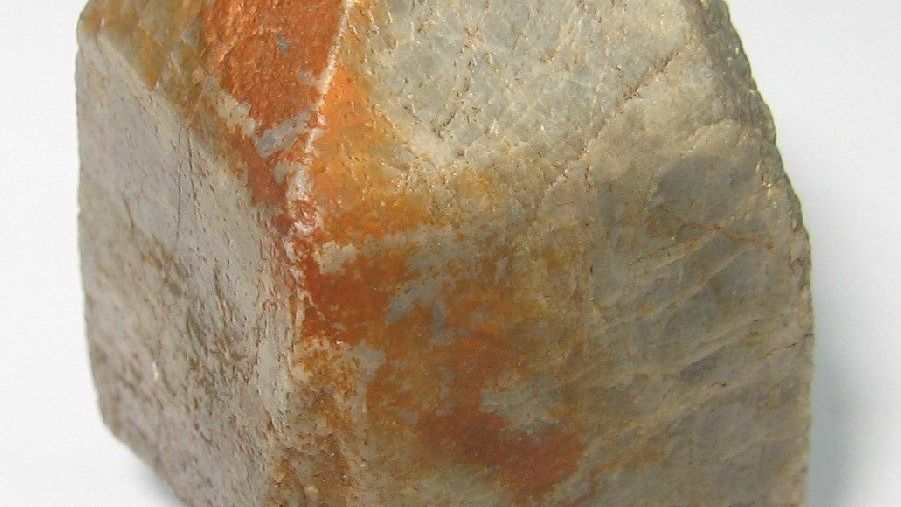
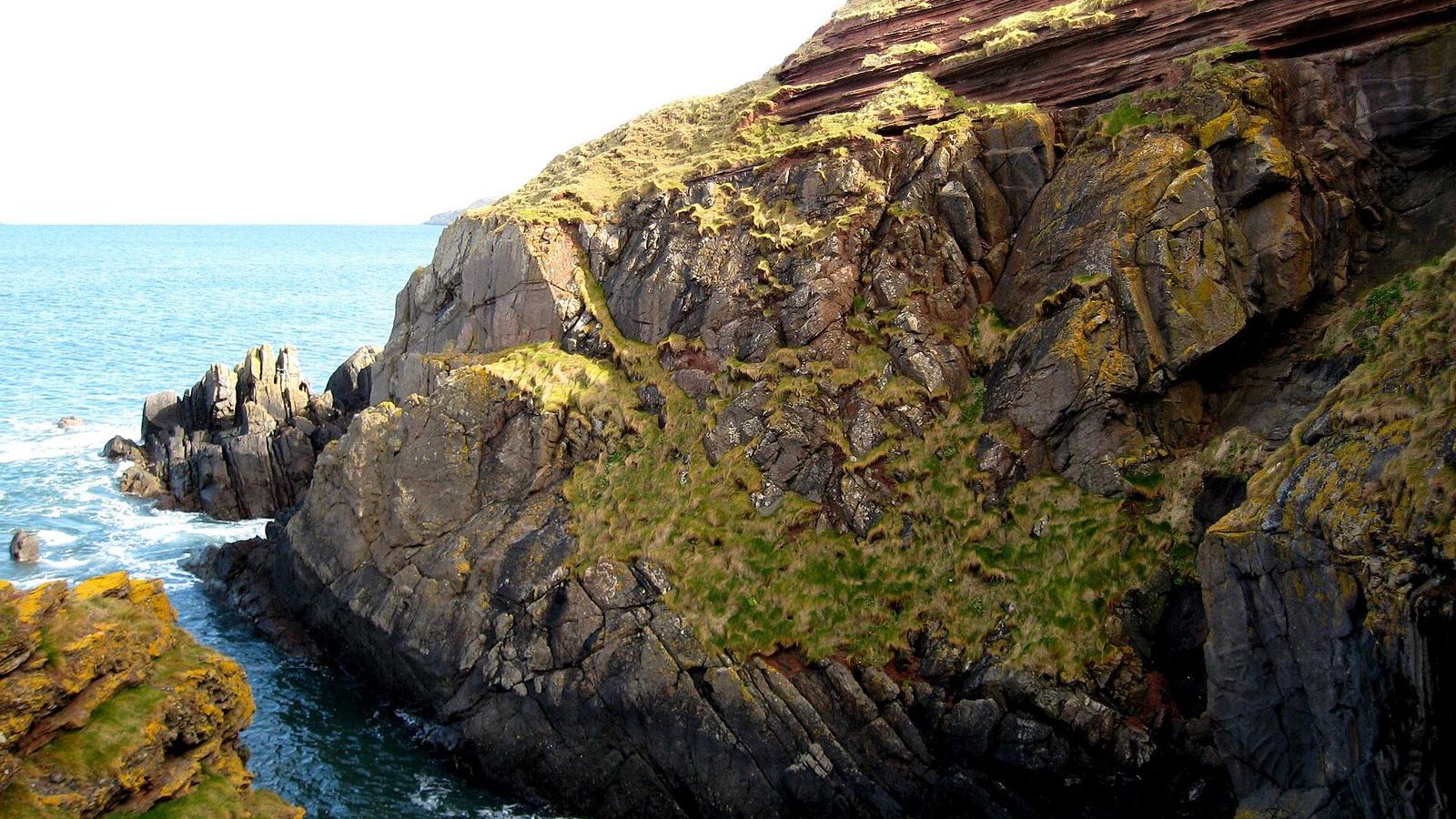
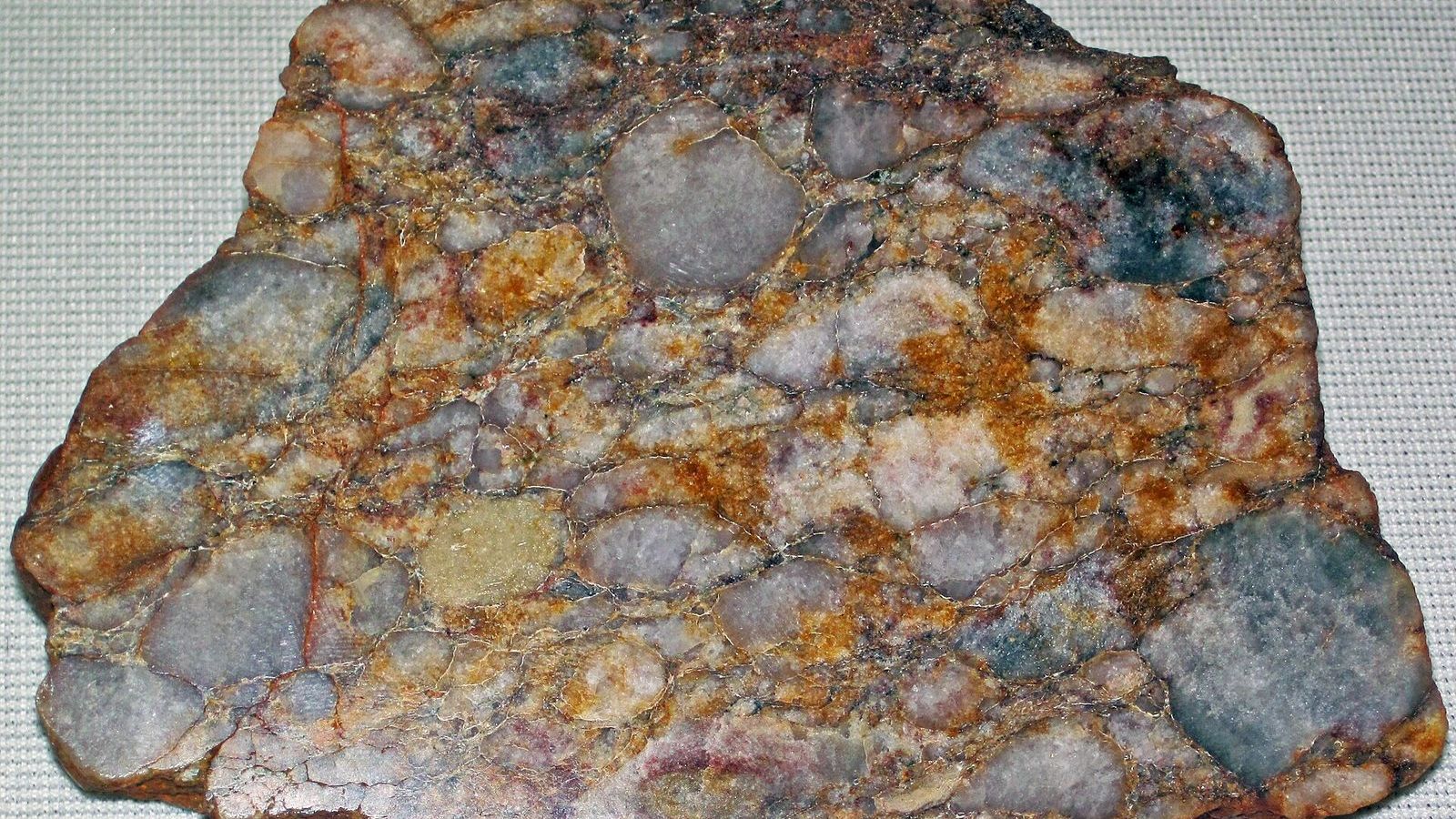
 Image: James St. John (CC BY 2.0)
The oldest pieces of the Earth are the size of sand grains
The oldest known pieces of the Earth would fit in a teaspoon. They are crystals of zircon, most of them between 0.1 and 0.3 mm across, weathered out of a low range of hills in the dry interior of Western Australia and dated at up to about 4,400 million years. The Earth itself is 4,540 million years old. No rock of that age survives anywhere; the oldest intact rock, the Acasta Gneiss of northern Canada, is 4,031 million years old. For the first 500 million years of the planet's history, these grains are nearly all we have.
Where they come from
The Jack Hills lie about 800 km north of Perth, on the Yilgarn craton, one of the old, stable cores of the continents. The rock that holds the zircons is a metaconglomerate, a conglomerate of quartz pebbles that was buried, heated, and hardened about 3,000 million years ago. The conglomerate is a river deposit. Its pebbles and sand grains were worn off older rocks upstream, carried, dropped, and buried, and among the sand grains were zircons from rocks that have since vanished.
Zircon is zirconium silicate, ZrSiO4. It forms in granitic magmas, it is hard (hardness 7.5 on the Mohs scale), it does not dissolve in water, and it survives being eroded out of one rock and deposited in another, then buried and metamorphosed, more or less unchanged. Geologists call such grains detrital, because they are debris from an older rock. Each one carries the age of the magma it crystallized in, which is why a zircon can be far older than the rock around it.
Most of the zircons in the Jack Hills conglomerate are between 3,300 and 3,800 million years old. A few percent are older than 3,900 million years, and a handful pass 4,300 million. The record holder was reported in 2001 by Simon Wilde and colleagues in the journal Nature, from a grain they labelled W74/2-36, with an age of 4,404 ± 8 million years from one part of the crystal. A separate measurement in 2014, by John Valley's group at the University of Wisconsin-Madison, used atom-probe tomography to show that the lead inside a similar grain had not moved since it formed, and settled on 4,374 ± 6 million years for that grain as the oldest confirmed age.
How a grain this small is dated
When zircon crystallizes, its structure takes in uranium in place of some of the zirconium, and it rejects lead almost completely. So a fresh zircon starts with uranium and no lead. Uranium-238 decays, through a chain of short-lived steps, to lead-206, with a half-life of 4,468 million years. Uranium-235 decays to lead-207 with a half-life of 704 million years. Any lead found inside the crystal today was made by that decay, and the ratio of lead to uranium gives the time since the crystal formed. The age equation, which the masterclass sets out in Unit 9, is
t = (1/λ) ln(1 + 206Pb/238U),
where λ is the decay constant of uranium-238, 1.55125 × 10⁻¹⁰ per year. For a 4,400-million-year-old grain the ratio of lead-206 atoms to uranium-238 atoms is about 0.98: nearly as much lead as uranium. For comparison, a zircon from a 250-million-year-old granite has a ratio of 0.04.
Two clocks in one crystal is what makes zircon trustworthy. If the uranium-238 age and the uranium-235 age agree, the grain is said to be concordant, and the age is taken as real. If the grain has lost lead, for example during a later heating, the two ages disagree in a predictable way and the geochronologist can see it. The Jack Hills grains were measured with an ion microprobe, which fires a beam of oxygen ions at a spot about 20 micrometres across on the polished surface of the crystal and counts the uranium and lead atoms that come off. One grain can be measured in several places, which matters, because many of these crystals have an old centre and a younger rim that grew around it during a later event.
What the oxygen says
An age alone would make the Jack Hills zircons a curiosity. What made them famous is their oxygen. Oxygen comes in three stable isotopes, and the ratio of oxygen-18 to oxygen-16 in a mineral, written δ18O and measured in parts per thousand against a standard, depends on where the oxygen came from. Zircon that crystallizes from a magma drawn straight from the mantle has a δ18O of about 5.3 ‰, and the value is remarkably constant. Rocks that have sat in liquid water at low temperature, such as clays and weathered lavas, take on heavier oxygen, with values of 10 ‰ and above. If such rocks are later buried and melted, the magma inherits the heavy oxygen, and so does the zircon that grows in it.
Several of the oldest Jack Hills zircons have δ18O values between 6.5 and 7.5 ‰, above the mantle value. The simplest reading is that the magma they grew in had melted rocks that had been weathered by liquid water at the surface, before 4,300 million years ago. This is the main evidence that the early Earth had oceans, or at least standing water, within about 200 million years of its formation, rather than the ocean of magma that older textbooks drew for the whole of the Hadean eon. The reading is not beyond dispute; the measurements are of a few grains, and a value of 7 ‰ is a modest shift that other processes can partly explain. It is, however, the reading that most geochemists accept, and no other evidence from that time contradicts it.
What else the grains carry
Some of the crystals hold inclusions, tiny grains of other minerals that were trapped as the zircon grew. Quartz and muscovite among them point to a granitic magma, which is a clue that something like continental crust existed early. A few grains have been reported with inclusions of graphite whose carbon isotopes resemble those of living matter; the claim of life at 4,100 million years rests on that and is treated by most geologists as unproven. The titanium content of zircon depends on the temperature at which it grew, and the Jack Hills grains give crystallization temperatures of about 680 °C, low for a magma, which again fits a wet, granite-like melt rather than a hot dry one.
The worked number
How much of the Earth's history do these grains cover? The Earth formed at 4,540 million years ago, a figure that comes from meteorites, the leftovers of the same process. The oldest Jack Hills zircon is 4,404 million years old. The gap is 136 million years, or 3 percent of the planet's age. The oldest rock, the Acasta Gneiss, is 4,031 million years old, which leaves a gap of 509 million years, 11 percent of the Earth's history, with no rock in it at all. Everything geologists say about those first 500 million years comes from a few thousand zircons, the Moon, and meteorites. The grains are small, and they carry a great deal.
The History of the Earth unit of the Geology Masterclass starts with the Hadean and these crystals, and Unit 9 works through the uranium-lead clock with the numbers. The original 2001 paper by Wilde and colleagues is at doi.org/10.1038/35051550, and the 2014 atom-probe confirmation by Valley and colleagues is at doi.org/10.1038/ngeo2075.